Hot flushes are only the start. The NHS names 16 symptoms of perimenopause and menopause, from period changes and palpitations to brain fog, joint pain and UTIs. Here is each one in plain English, what helps, and when to talk to a GP.

Last reviewed 18 October 2026 · Checked against NHS guidance · 19 min read
The short answer
The NHS lists these symptoms of perimenopause and menopause: changes to your periods, hot flushes and night sweats, sleep problems, mood changes, poor memory and brain fog, weight gain, vaginal dryness or itching, more UTIs, plus palpitations, bone density loss, leaking urine or peeing more often, worse headaches, joint and muscle pain, hair thinning, dry itchy skin, a lower sex drive and mouth or gum problems. Symptoms usually last 7 to 9 years, sometimes longer. Most can be eased with lifestyle changes, CBT, HRT or other treatments, so talk to a GP if they are affecting your life. Any bleeding after 12 months without a period needs checking.
This is the starting point for our menopause guides. Each symptom below links to a deeper article, starting with the early signs of perimenopause and what actually helps hot flushes and night sweats. Every fact comes from the NHS website and the NICE menopause guideline.
Perimenopause, menopause and postmenopause: what the words mean
The NHS describes menopause and perimenopause as a natural part of life, when your periods change and eventually stop because hormone levels fall. It can affect anyone who has periods. The words get used loosely, so here is how they fit together.
- Perimenopause is the time when your periods become irregular. Symptoms can start at this stage, while you are still having periods, which is why they are easy not to connect with menopause at first.
- Menopause is when your periods have stopped altogether. The NHS defines it as not having a period for 12 months when you are not using hormonal contraception.
- Postmenopause is the usual name for the years that follow. The NHS notes that some symptoms, such as joint pain and vaginal dryness, can continue after menopause.
What age does menopause start in the UK?
The NHS says menopause usually happens between 45 and 55. The NICE menopause guideline gives the average age in the UK as 51. It can happen earlier: menopause before 45 is called early menopause, and before 40 premature menopause. NICE says about 1 in 100 women have premature ovarian insufficiency, meaning menopause before 40.
Early menopause can happen naturally, sometimes for no clear reason, or after surgery to remove the ovaries, radiotherapy, chemotherapy or some hormone medicines. The NHS says a family history, starting periods early, smoking and being underweight can also raise the chance.
How long do symptoms last? The NHS says they usually last 7 to 9 years, sometimes longer, and that they can change over that time. The NHS also says menopause is different for everyone: some people have symptoms that have a big impact on daily life, others have few. Knowing that they come and go explains why a single bad week tells you less than a pattern over two months. Our guide to perimenopause signs goes deeper on the early stage.
Are there really 34 symptoms of menopause?
Search for menopause symptoms and you will find lists of 34, 48 and even 62. None of these numbers comes from the NHS or NICE, and the pages using them rarely say where the count comes from. Long lists tend to split one symptom into several (for example "itchy skin", "dry skin" and "crawling skin") or add things that have many other causes.
The NHS does not give a number. Its symptoms page has 7 headed sections and a list of 9 "other" symptoms, which adds up to 16. That is the list we use in this guide. It is not the whole story for everyone, and the NHS itself says menopause "may affect you in other ways", but it is the list a UK GP will recognise. If you have a symptom that is not here, it is still worth mentioning, because a GP can check whether something else is going on.
The symptom map: all 16 NHS symptoms in 3 groups
We have grouped the NHS list into three areas, because the things that help tend to follow the same lines. In the map, mood and brain fog are shown as two tiles, although the NHS puts them under one heading.
Body and period symptoms, and what helps each one
These are the physical changes. Each block gives the NHS description, then what helps, then where to read more.
Changes to your periods
The NHS says a change to your periods is usually one of the first signs of perimenopause. They may come more often or less often, and bleeding may get heavier or lighter, before they eventually stop.
Hot flushes and night sweats
Hot flushes are when your face, neck and chest suddenly feel very hot or cold. The NHS says they can make you sweat a lot, cause palpitations or anxiety, or make you feel dizzy. NICE names hot flushes and night sweats as the most common symptoms.
Palpitations
The NHS describes palpitations as a faster, slower or more noticeable heartbeat. They can come with a hot flush or on their own.
Headaches and migraines
The NHS lists headaches and migraines that are worse than usual among the other symptoms of menopause and perimenopause.
Joint pains and muscle aches
Muscle aches and joint pains are on the NHS list, and NICE mentions joint and muscle stiffness. The NHS notes that joint pain is one of the symptoms that can continue after menopause.
Weight gain
The NHS says weight gain during perimenopause and menopause is common, and often happens around the stomach and upper body.
Skin, hair and mouth changes
Three symptoms from the NHS "other" list sit together here: skin changes, including dry and itchy skin; hair thinning or hair loss; and sensitive teeth, painful gums or other mouth problems.
Bone density loss
This is the one symptom you cannot feel. The NHS lists loss of bone density, which can lead to osteoporosis, as an effect of menopause. We cover it in the long-term health section below.
Know what you have. Now show your GP the pattern.
This guide tells you what each symptom is. Menopause Symptom Tracking & GP Appointment Prep (£12.99, Foundation, 1 hr 10 min) gives you 8 weeks of tracking turned into a GP conversation: the tracker, a script, the questions to ask and a readiness check before you book.
Vaginal, bladder and sex symptoms, and what helps
These are the symptoms women are least likely to raise, yet there are simple treatments that help. The NHS notes that vaginal dryness can carry on after menopause, so it is worth asking early rather than waiting for it to pass.
Vaginal dryness, burning, irritation or itching
The NHS says you may get dryness, a burning feeling, irritation or itching in and around the vagina, which can make sex painful. Vaginal dryness is one of the symptoms that can continue after menopause.
More UTIs, or symptoms that feel like one
The NHS says you may get more urinary tract infections, or symptoms that feel like a UTI, such as pain or a burning feeling when you pee, or needing to pee more often. For a closer look, see our guide: Menopause brain fog.
Leaking urine or needing to pee more often
Urinary incontinence, or needing to pee more often, is on the NHS list of other menopause symptoms.
Lower sex drive
A reduced sex drive is on the NHS list, and NICE mentions a lack of interest in sex. Painful sex from vaginal dryness can feed into it.
Mind and sleep symptoms, and what helps
These are easy to mistake for stress or simply being busy. They can also feed each other: the NHS says sleep problems can leave you irritable, stressed and anxious.
Sleep problems
The NHS says not being able to get to sleep or stay asleep can affect your daily life, making you feel irritable, stressed and anxious. Sleep problems may be worse if you also have night sweats.
Mood swings, low mood and anxiety
The NHS says you may have mood swings, low mood or depression, and that hot flushes can bring on anxiety.
Poor memory, concentration and brain fog
The NHS groups poor memory and brain fog with mood changes. NICE describes memory and concentration loss among the symptoms.
If you feel you cannot cope
Low mood that does not lift, or thoughts of harming yourself, need help now rather than at a routine appointment. The NHS says to call 111 and choose the mental health option, call Samaritans free on 116 123, or call 999 or go to A&E if your life is at risk. If you are 18 or over and registered with a GP, the NHS says you can also refer yourself to NHS talking therapies without speaking to a GP first.
Symptom snapshot: what are you living with?
Tick anything you have noticed in the last few months. You will see your count by group, the guides that match, and a short list to take to your GP. Nothing is saved.
Body and periods
Vaginal, bladder and sex
Mind and sleep
About you
Tick a symptom to start
Your snapshot will build here as you go.
A prompt for a conversation, not a diagnosis. Only a GP can confirm menopause or rule out other causes.
Treatments at a glance: what a GP can offer
NICE says your healthcare professional should talk through all the options with you, including benefits and risks, and that decisions are best made together, taking into account your age, medical history and preferences. These are the main options the NHS describes.
| Option | What it is | Symptoms the NHS links it to |
|---|---|---|
| HRT: oestrogen | The main hormone in HRT, as tablets, patches, spray or gel. If you still have your womb you also need a progestogen, as tablets, a combined patch or a hormonal coil (IUS). | Most symptoms, including hot flushes, night sweats, sleep problems, anxiety, low mood and vaginal dryness. Also helps prevent osteoporosis. |
| Vaginal oestrogen | Creams, pessaries, gels or a vaginal ring that treat the area directly. | Vaginal dryness and soreness, and urinary symptoms. |
| Testosterone | Gel or cream, which a menopause specialist may prescribe. | Low sex drive, for some people. |
| CBT | A talking therapy. | Hot flushes, low mood, anxiety and sleep problems. |
| Non-hormonal medicines | Clonidine or an antidepressant for flushes; antidepressants for mood. | Hot flushes and night sweats; low mood, depression or anxiety. |
| Herbal remedies | Such as red clover and black cohosh. | The NHS says there is very little evidence on how well they work or how safe they are, and they can cause serious side effects with other medicines. Check with a doctor first. |
Is HRT safe?
The NHS says the risk of serious side effects from HRT is usually very low, and depends on the type, how long you take it and your own health. If you are under 60, have menopause symptoms and are not at high risk of breast cancer or blood clots, the NHS says the benefits are likely to outweigh the risks. Combined HRT slightly increases the risk of breast cancer, while oestrogen-only HRT has little or no effect on it. Tablets slightly raise the risk of blood clots, which is still very low, but patches, sprays and gels do not. People who have had breast cancer are usually advised not to take HRT. Our full guide, HRT explained, covers the types and risks in detail. For your own situation, speak to your GP or pharmacist.
Bones and heart: the long view
Menopause is not only about how you feel day to day. Lower oestrogen affects your bones, and an early menopause affects your heart risk too.
- Bones. The NHS lists bone density loss, which can lead to osteoporosis, as an effect of menopause. NICE says women should be given advice on bone health and that it should be discussed at review appointments. HRT helps prevent bone thinning, which the NHS says matters most if your periods stop before 45.
- Heart. The NHS says early menopause raises the risk of cardiovascular disease as well as osteoporosis, which is why replacing the missing hormones is emphasised for women who reach menopause early. NICE says HRT does not increase cardiovascular disease risk when started under 60, and the NHS says research shows little or no effect on coronary heart disease.
For food, the NHS points to a healthy, balanced diet with plenty of fruit and vegetables and calcium sources such as milk, yoghurt and kale. Our menopause diet guide turns that into everyday meals, and the Complete Menopause Nutrition Course (£24.99, Premium) builds bone- and heart-friendly eating into a 7-day planner and a 90-day plan.
How menopause is diagnosed in the UK
Many women expect a blood test. For most, there is not one. The NICE guideline sets out three routes, depending on age:
- Over 45: for otherwise healthy women, NICE says GPs should diagnose perimenopause from hot flushes or night sweats plus irregular periods, and menopause after 12 months without a period (when you are not on hormonal contraception), without laboratory tests.
- 40 to 45: NICE says a GP may consider an FSH blood test if you have menopause symptoms, including a change in your cycle.
- Under 40: premature ovarian insufficiency is diagnosed from symptoms plus raised FSH levels on 2 blood samples taken 4 to 6 weeks apart. NICE says it should not be diagnosed from a single blood test.
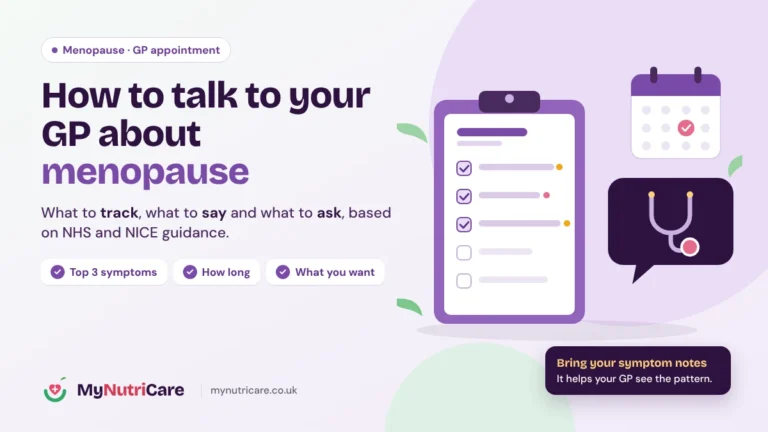
That is why your own record matters so much. The more clearly you can describe what has changed, when and how often, the easier it is for a GP to recognise the pattern. Our menopause GP appointment guide shows what to bring and what to ask.
When to see a GP about menopause symptoms
The NHS says see a GP if...
- you think you have symptoms of menopause or perimenopause and want to know your options
- you have symptoms such as palpitations
- you still have periods and are bleeding more than before
- you are on HRT and still have irregular or heavier bleeding, or spotting, after 6 months
- you are under 45 and think you have menopause symptoms: a GP may sometimes offer blood tests
- you have not had a period for 12 months or more and have any vaginal bleeding, even once, even if it is only spotting, or if you are not sure it is blood
The NHS says bleeding after menopause is usually not serious, but it can occasionally be a sign of cancer, so it always needs checking.
For early menopause, the NHS says a specialist menopause centre can be considered if symptoms carry on. The NHS also points to charities such as The Menopause Charity, Women's Health Concern (run by the British Menopause Society) and Rock My Menopause.
When symptoms follow you to work
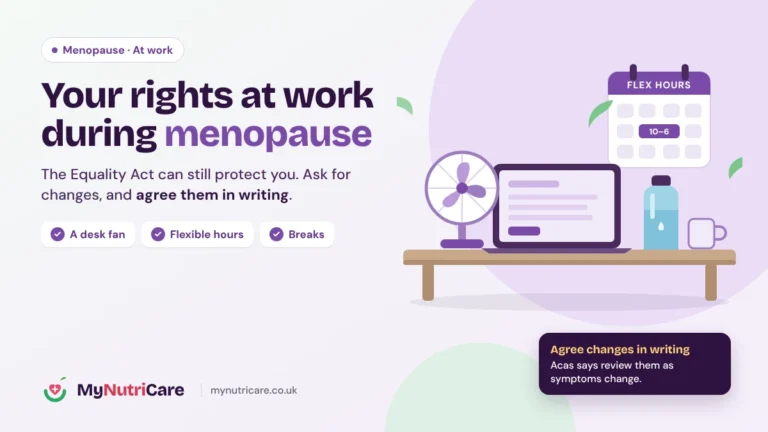
Hot flushes in meetings, broken sleep and brain fog do not stay at home. If symptoms are affecting your work, you do not have to manage alone or in silence. Our guide to menopause at work in the UK covers how to raise it with your manager, the adjustments people commonly ask for and where the official guidance sits. The Menopause at Work course (£17.99) adds a ready-to-send adjustments request letter, a symptom diary and a manager conversation script.
From a list of symptoms to a plan
This article gives you the full list and the first steps for each symptom. What it cannot do is help you track your own pattern over weeks, prepare for a GP appointment or plan for each stage. That is what our menopause courses are for. Not sure where to start? Our guide to choosing a course by goal can help.
The Complete Menopause Guide
Every stage in one place, from first signs to life after menopause, with a symptom tracker, a GP appointment summary and a clear guide to who to ask for help.
Symptom Tracking & GP Appointment Prep
8 weeks of tracking turned into a GP conversation, with a script, the questions to ask and a readiness check.
Understanding HRT and Other Treatment Options
HRT and non-hormonal options explained in plain English, based on NHS guidance, with clear questions for your GP.
Full refund within 14 days if you have completed less than 20% of the course and no certificate has been issued. Our courses are education, not treatment, and do not replace advice from your GP.
Related guides
- Perimenopause signs: the early changes and how to tell if it has started.
- HRT explained: types, benefits and risks, as the NHS describes them.
- Your menopause GP appointment: what to bring and what to ask.
- The menopause diet: eating for bones, heart and energy.
Questions women ask about menopause symptoms
What are usually the first signs of perimenopause?
The NHS says one of the first signs is usually a change to your periods: they may come more or less often, and bleeding may get heavier or lighter. Hot flushes, night sweats, sleep problems and mood changes can start at the same stage, while you are still having periods.
Are there really 34 symptoms of menopause?
Neither the NHS nor NICE gives that number. The NHS lists 16 symptoms: 7 main ones (period changes, hot flushes and night sweats, sleep problems, mood and memory changes, weight gain, vaginal problems and UTIs) and 9 others, including palpitations, joint pain, headaches, hair thinning, skin changes and bone density loss.
How long do menopause symptoms last?
The NHS says symptoms usually last 7 to 9 years, sometimes longer, and can change over that time. Some, such as joint pain and vaginal dryness, can continue after menopause.
What is the average age of menopause in the UK?
The NICE menopause guideline gives the average age in the UK as 51. The NHS says it usually happens between 45 and 55. Menopause before 45 is called early menopause, and before 40 premature menopause.
Do I need a blood test to confirm menopause?
Usually not if you are over 45. NICE says GPs should diagnose perimenopause and menopause from your symptoms and periods without laboratory tests. A blood test may be considered between 40 and 45, and is used to diagnose premature ovarian insufficiency under 40.
Can menopause cause palpitations and anxiety?
Yes. The NHS lists palpitations as a menopause symptom and says hot flushes can cause palpitations or anxiety. It also lists palpitations as a reason to see a GP, so get them checked rather than assuming they are hormonal.
When should I see a GP about menopause symptoms?
The NHS says see a GP if you want to know your options, have palpitations, are bleeding more than before, are under 45 with symptoms, or have any vaginal bleeding after 12 months without a period, even just once.
Sources
- NHS: Menopause and perimenopause
- NHS: What are menopause and perimenopause? (last reviewed 19 May 2026)
- NHS: Symptoms of menopause and perimenopause (last reviewed 19 May 2026)
- NHS: Things you can do for menopause and perimenopause (last reviewed 19 May 2026)
- NHS: Treatment for menopause and perimenopause (last reviewed 19 May 2026)
- NHS: Help and support for menopause and perimenopause
- NHS: Early or premature menopause
- NHS: Benefits and risks of HRT
- NHS: Urinary incontinence treatment
- NHS: Where to get urgent help for mental health
- NHS: NHS talking therapies
- NICE NG23: Menopause: identification and management (recommendations, context and information for the public)
This article is general information based on UK public health guidance. It is not medical advice. If you have symptoms, a health condition, or questions about treatment, speak to your GP or pharmacist.