A hot flush can arrive in a meeting, on the bus or at 3am, and it can leave you drenched. Here is what the NHS says is going on, the triggers worth watching, and a simple cool-down plan for the day, the office and the night.
Last reviewed 18 October 2026 · Checked against NHS guidance · 13 min read
The short answer
A hot flush is when your face, neck and chest suddenly feel very hot or cold. It can make you sweat a lot and last for several minutes, and when it happens at night it is called a night sweat. There is no off switch, but the NHS suggests lightweight clothing, a cool bedroom, a fan, a cool shower or a cold drink, and cutting back on potential triggers such as spicy food, caffeine, hot drinks, smoking and alcohol. Exercise, a healthy weight, lower stress and CBT can help too. If flushes are affecting your life, talk to your GP: HRT is effective for hot flushes and night sweats, and there are other options if HRT is not suitable.
Hot flushes are one of the most common menopause symptoms, but far from the only one. Our full UK list of menopause symptoms and what helps each one covers the rest. This guide goes deep on flushes and sweats alone, and every fact comes from NHS, NICE or ACAS guidance.
What a hot flush is, and how long they go on
The NHS describes a hot flush as your face, neck and chest suddenly feeling very hot or cold. It can make you sweat a lot, cause palpitations or anxiety, or make you feel dizzy. It can happen during the day or at night, and it can last for several minutes.
Night sweats are the same thing happening while you sleep. Sleep problems are a separate menopause symptom in their own right, and the NHS notes they may be worse if you also have night sweats. Poor sleep can leave you irritable, stressed and anxious, so the night plan below matters as much as the daytime tips.
Why they happen
Menopause and perimenopause happen when your periods change and eventually stop due to lower hormone levels. The NHS lists hot flushes among the common symptoms, alongside low mood, sleep problems and memory problems. The NHS groups menopause and perimenopause symptoms together and says to contact your GP if you think you have symptoms of either and want to know your options, so you do not have to wait for your periods to stop before getting help. Our guide to early perimenopause signs explains that stage.
How long will this last?
The NHS says menopause symptoms usually last for 7 to 9 years, sometimes longer, and can change during this time. The NHS adds that early advice can help reduce those effects, so it is worth acting early rather than waiting it out.
Common triggers, and what to try instead
The NHS advises you to avoid or reduce potential triggers, such as spicy food, caffeine, hot drinks, smoking and alcohol. The word "potential" matters: not everyone reacts to every trigger, and the only way to find yours is to notice what happened in the hour or so before a flush, over several flushes.
| Trigger | Source | What the guidance says | A simple swap to test |
|---|---|---|---|
| Spicy food | NHS trigger list | Named by the NHS as a potential trigger to avoid or reduce. | Try milder versions of favourite dishes for a fortnight and see if flushes after meals change. |
| Caffeine | NHS trigger list | A potential trigger. The NHS insomnia advice also says not to drink tea or coffee at least 6 hours before bed. | Switch some cups to decaf, especially from the afternoon. |
| Hot drinks | NHS trigger list | Listed separately from caffeine, so it is worth testing hot drinks on their own. | Let drinks cool, or swap one for a cold drink, which the NHS also suggests for cooling down. |
| Alcohol | NHS trigger list | The NHS says try not to drink more than the recommended limit: no more than 14 units a week on a regular basis, spread over 3 or more days. | Have several drink-free days each week and note whether evenings or nights feel different. |
| Smoking | NHS trigger list | The NHS says do not smoke, as it can make menopause symptoms worse. | Ask your GP or pharmacist about NHS stop smoking support. |
| Stress | NHS cooling advice | The NHS lists finding ways to reduce your stress level among the things that ease hot flushes. | Try a relaxing activity such as yoga, tai chi or meditation, which the NHS suggests. |
| Warm rooms and heavy clothes | NHS cooling advice | The NHS suggests lightweight clothing and keeping your bedroom cool at night. | Open a window or use a fan, and choose thin layers you can take off. |
The NHS names the first five as potential triggers. Stress and heat come from its advice on easing flushes, so they are worth testing too.
Trigger finder (quick)
Think back to your most recent flush. Tick anything that happened in the hour or so before it, and pick when it happened. You will get one NHS-based tip for each. Nothing is saved.
What happened before the flush? Tick all that apply.
When did it happen?
Tick what happened above
Your possible triggers and a tip for each will appear here.
One flush is a clue, not proof. Patterns show up over a few weeks of notes.
8 NHS ways to ease hot flushes
These are the steps the NHS lists for easing hot flushes and night sweats, with notes on making each one work on an ordinary day.
- Wear lightweight clothingThin layers you can take off quickly make this easier when a flush starts in a shop, at your desk or on the school run.
- Cool down fastThe NHS suggests taking a cool shower, using a fan or having a cold drink. A small fan and a refillable bottle of cold water in your bag cover two of the three.
- Keep your bedroom cool at nightCovered in the night-time plan below, because night sweats need a set-up you can manage half-asleep.
- Avoid or reduce potential triggersSpicy food, caffeine, hot drinks, smoking and alcohol. Change one thing at a time so you can tell what made the difference.
- Find ways to lower your stressThe NHS suggests relaxing things such as yoga, tai chi or meditation, and talking to others going through the same thing, like family, friends or colleagues.
- Exercise regularlyThe NHS menopause advice puts the focus on weight-bearing exercise to build strength, which also helps protect your bones.
- Keep to a healthy weightListed by the NHS as one of the ways to ease hot flushes. Our guide to menopause weight gain covers realistic changes.
- Ask about CBTThe NHS says cognitive behavioural therapy can also help manage hot flushes. It is a talking therapy where a therapist helps you change how you think and act.
The NHS also says to talk to a doctor before taking herbal supplements or complementary medicines. More on that in the treatments section.
Your night-time plan for night sweats
Night sweats can wake you soaked and make it hard to drop off again. The plan below puts the NHS cooling advice and its sleep advice side by side, so you can see what changes between day and night.
Before bed
- Cool the room. The NHS advice is to keep your bedroom cool at night. Open a window or turn the heating down before you get in.
- Make it dark and quiet. The NHS insomnia advice suggests curtains, blinds, an eye mask or ear plugs if needed.
- Mind the timing. The same advice says not to smoke or drink alcohol, tea or coffee for at least 6 hours before bed, which also covers four of the NHS flush triggers.
- Wind down. Relax for at least 1 hour before bed, avoid screens right before bed, and avoid exercise in the 4 hours before bed, while still exercising regularly during the day.
- Set up your kit. Lightweight nightwear, a cold drink and a fan within reach, plus a spare top and towel nearby.
When a night sweat wakes you
- Have the cold drink and turn the fan towards you.
- Change into the dry top rather than lying in damp clothes.
- If you are wide awake, a cool shower is one of the NHS cooling options.
- Keep the lights low and try to keep to your usual wake-up time the next day. The NHS recommends regular sleep routines and getting up at the same time every day.
If changing your habits has not helped, you have had trouble sleeping for months, or tiredness is making it hard to cope, the NHS says to see a GP. For a fuller night plan, Sleep and Menopause (£14.99, 2 hr) includes a night symptom diary, a bedroom cooling checklist and calm back-to-sleep audio. You can browse more options in our sleep courses.
Coping with hot flushes at work
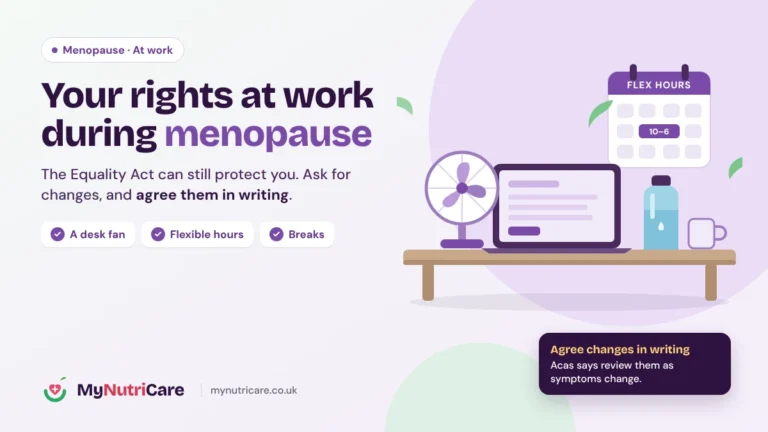
ACAS, the official workplace advice service, lists things employers could look at in a menopause risk assessment. Several map directly onto hot flushes:
Temperature and air
The temperature and ventilation of the workplace. A desk near a window or a personal fan are the kind of changes you could ask about.
Uniform
The material and fit of any uniform, and whether it might make you feel too hot or cause discomfort.
Cold water
Whether cold drinking water is available, which links straight to the NHS "have a cold drink" advice.
Somewhere to recover
Whether there is somewhere suitable to rest if needed, such as a quiet room, and whether toilets are easy to reach.
ACAS also says employers should review flexible working policies, which matters if night sweats are wrecking your sleep. Our guide to menopause at work in the UK covers your rights and how to raise it, and the Menopause at Work course (£17.99, 2 hr) gives you an adjustments request letter, a symptom diary and a manager conversation script. For a closer look, see our guide: Exhausted With a Newborn.
Treatments to ask your GP about
If lifestyle changes are not enough, these are the options the NHS and NICE describe. Your GP or pharmacist can tell you what suits you.
| Option | What the guidance says | Good to know |
|---|---|---|
| HRT | The NHS says HRT is effective at relieving most menopause symptoms, including hot flushes and night sweats. NICE recommends offering HRT for hot flushes and night sweats, after talking through its benefits and risks with you. | Symptoms should improve after a few days or weeks. |
| CBT | The NHS says you may be offered CBT for hot flushes and night sweats. | A talking therapy, not a medicine. Ask your GP how to access it. |
| Fezolinetant | NICE (2026) says it can be used as an option for moderate to severe hot flushes and night sweats associated with menopause when HRT is unsuitable. | NICE says it is available on the NHS. Ask your GP whether it is suitable for you. |
| Clonidine | The NHS says a doctor may suggest it if CBT does not help. It does not affect hormone levels. | It may take 2 to 4 weeks to work. Side effects can include dry mouth, drowsiness, depression and constipation. |
| Antidepressants | The NHS says a doctor may suggest one if CBT does not help. | NICE says SSRIs, SNRIs or clonidine should not routinely be offered as first-line treatment for these symptoms alone. |
| Herbal remedies | The NHS says there is very little evidence on how well they work or how safe they are. NICE notes some evidence that isoflavones or black cohosh may relieve flushes, but that preparations vary and their safety is uncertain. | Some, especially St John's wort, can interact seriously with other medicines. Speak to a GP or pharmacist first. |
About HRT risks
The NHS says the risk of serious side effects is usually very low. HRT can slightly increase the risk of breast cancer (around 5 extra cases in every 1,000 women taking combined HRT for 5 years), and HRT tablets can increase the risk of blood clots, although the risk is still very low. If you are at risk of blood clots you will usually be advised to use patches, spray or gel instead of tablets, and if you have had breast cancer you will usually be advised not to take HRT. Our HRT explained guide goes through the types and the risks in full.
Want to go in prepared? Understanding HRT and Other Treatment Options (£17.99, 2 hr) explains HRT and non-hormonal options using NHS guidance and gives you clear questions for your GP.
When night sweats might be something else
Not every night sweat is the menopause. The NHS says it is normal to sweat at night if your room or bedding is making you too hot. Night sweats are different: you sweat so much that your nightclothes and bedding are soaking wet. Menopause is one of the most common causes, but the NHS lists others too:
- anxiety
- medicines, such as some antidepressants, steroids and painkillers
- low blood sugar (hypoglycaemia)
- alcohol or drug use
- hyperhidrosis, a harmless condition that causes excessive sweating
Sometimes the cause is not known. If a medicine could be behind it, a GP may prescribe a different one, so do not stop any medicine on your own.
See a GP if...
- night sweats happen regularly and wake you up or worry you
- you also have a very high temperature or feel hot, cold or shivery
- you have a cough or diarrhoea as well
- you have night sweats and are losing weight for no clear reason
- you have a fast heartbeat (palpitations)
- you think you have menopause or perimenopause symptoms and want to know your options
Bleeding after the menopauseThe NHS says to contact your GP if you have not had a period for 12 months or more and you have any vaginal bleeding, even if it has only happened once.
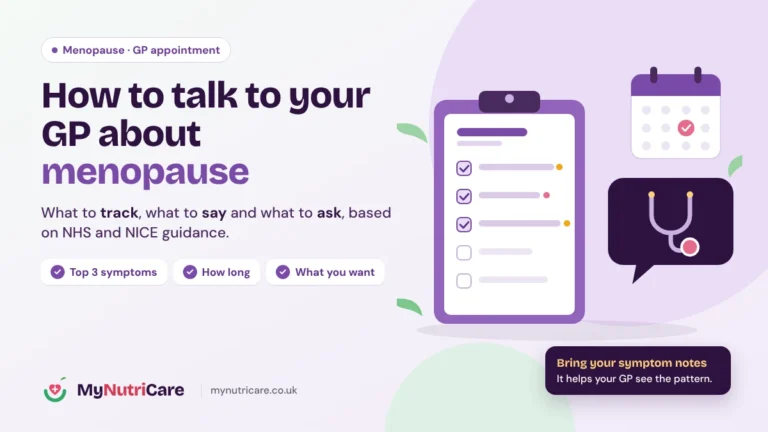
A short symptom log makes that appointment far more useful. Our guide to preparing for a menopause GP appointment shows what to bring and what to ask.
Ready to find your own pattern?
This article gives you the NHS facts and one quick check. The courses give you the trigger diary, checklists and plans to track flushes over weeks, try changes one at a time, and take a clear record to your GP.
Hot Flushes and Night Sweats: Practical Coping
Trigger diary, cooling checklists for home and work, and a night-time plan.
Sleep and Menopause
Night symptom diary, bedroom cooling checklist and calm back-to-sleep audio.
The Complete Menopause Guide
Every stage in one place, with a symptom tracker, GP appointment summary and who to ask for help.
Full refund within 14 days if you have completed less than 20% of the course and no certificate has been issued. Courses are for education and do not treat any condition.
Related guides
- Menopause mood changes and anxiety: when flushes come with a racing heart or worry.
- HRT explained (UK): types, benefits and risks in plain English.
- Your menopause GP appointment: what to track and what to ask.
- Menopause at work (UK): adjustments and how to ask for them.
Questions women ask
How do you stop hot flushes?
There is no instant off switch, but the NHS suggests lightweight clothing, a cool bedroom, a cool shower, a fan or a cold drink, lower stress, regular exercise, a healthy weight, and avoiding potential triggers such as spicy food, caffeine, hot drinks, smoking and alcohol. CBT can also help. If flushes affect your life, ask your GP about HRT and other options.
How long does a hot flush last?
The NHS says a hot flush can last for several minutes and can happen during the day or at night. Menopause symptoms in general usually last for 7 to 9 years, sometimes longer, and can change during that time.
What triggers hot flushes?
The NHS names spicy food, caffeine, hot drinks, smoking and alcohol as potential triggers to avoid or reduce. Noting what happened before each flush over a few weeks helps you find your own.
How can I stop night sweats during the menopause?
Keep your bedroom cool, wear lightweight nightwear, and keep a fan and a cold drink by the bed. The NHS also advises regular sleep routines and no alcohol, tea or coffee for 6 hours before bed.
When should I worry about night sweats?
The NHS says to see a GP if night sweats happen regularly and wake you up or worry you, if you also have a very high temperature, feel hot, cold or shivery, or have a cough or diarrhoea, or if you are losing weight for no clear reason.
Are there treatments for hot flushes other than HRT?
Yes. The NHS says CBT may be offered, and a doctor may suggest clonidine or an antidepressant if CBT does not help. NICE says fezolinetant can be used as an option for moderate to severe hot flushes and night sweats when HRT is unsuitable. Speak to your GP about what suits you. You can browse every course and guide on the My Nutri Care home page.
Sources
- NHS: Symptoms of menopause and perimenopause (last reviewed 19 May 2026)
- NHS: Things you can do for menopause and perimenopause symptoms (last reviewed 19 May 2026)
- NHS: Treatment for menopause and perimenopause (last reviewed 19 May 2026)
- NHS: What are menopause and perimenopause? (last reviewed 19 May 2026)
- NHS: Night sweats
- NHS: Benefits and risks of HRT
- NHS: Other medicines for menopause symptoms
- NHS: Herbal remedies and complementary medicines for menopause symptoms
- NHS: Insomnia
- NHS: Alcohol units
- NICE NG23: Menopause: identification and management
- NICE TA1143: Fezolinetant for treating moderate to severe vasomotor symptoms associated with menopause (2026)
- ACAS: Supporting staff through the menopause (last updated 7 April 2026)
This article is general information based on UK public health guidance. It is not medical advice. If you are worried about hot flushes, night sweats or any new symptom, speak to your GP or pharmacist. In an emergency, call 999.