For most women the first clue is not a hot flush but a period that arrives early, late, heavier or lighter than usual. Here is what the early stage looks like, the ages that matter, whether you can still get pregnant, and why most women over 45 do not need a blood test.

Last reviewed 18 October 2026 · Checked against NHS guidance · 12 min read
The short answer
You may be perimenopausal if you are in your 40s and your periods have started to change: coming more or less often, or getting heavier or lighter. The NHS says this is often the first sign. Hot flushes, poor sleep, low mood and memory problems are other common signs. Menopause usually happens between 45 and 55. If you are over 45, NICE says a GP can usually diagnose perimenopause from your symptoms and periods, without a blood test. You can still get pregnant, so keep using contraception until your GP says you can stop. If you are under 45, or your bleeding is heavier than before, see your GP.
This guide zooms in on the early stage: how to tell whether those changes might be perimenopause, and what to do next. For every symptom across all the stages, with what helps each one, see our full UK list of menopause symptoms. Everything below comes from current NHS pages and the NICE menopause guideline.
Period changes: usually the first sign
Perimenopause is the stage when your periods become irregular. Menopause is when they stop altogether. Both happen because hormone levels fall, and the NHS says a change in your periods is often the very first sign that perimenopause has started.
The NHS describes periods becoming more frequent or less frequent, and bleeding becoming heavier or lighter, until they stop altogether. One odd month tells you little. A pattern over several months, alongside other symptoms, tells you and your GP far more, so it is worth writing down the dates and how heavy each period is.
Heavier bleeding is a reason to see your GP
The NHS says to see a GP if your bleeding pattern has changed and you are bleeding more heavily than before. Do not assume heavier periods are "just the menopause" without getting them checked.
When your contraception hides the signs
The NHS explains that the progestogen-only pill, the hormonal coil (IUS), the implant and the injection can make periods irregular or stop them, and the combined pill gives a monthly withdrawal bleed. So if you use hormonal contraception, you may not see this first sign at all. Your other symptoms become the main clues, so tell your GP which contraception you use.
8 early signs to look out for
The NHS stresses that everyone is different: some women have significant symptoms, others few or none, and Black women are more likely to have severe, long-lasting hot flushes. These are the signs most worth knowing early on:
- Changing periodsMore or less frequent, heavier or lighter. Often the first sign, as above.
- Hot flushesSudden heat or cold in the face, neck and chest, sometimes with sweating, palpitations, anxiety or dizziness. They can last several minutes. More in our guide to hot flushes and night sweats.
- Night sweatsHot flushes that happen at night, which can disturb your sleep.
- Sleep problemsTrouble getting to sleep or staying asleep, which can leave you irritable, stressed or anxious.
- Mood changesMood swings, low mood, anxiety or depression. See menopause, mood and anxiety.
- Memory and concentrationForgetting words or losing focus, which can get worse with poor sleep. Our guide to menopause brain fog goes deeper.
- Vaginal drynessDryness, burning, irritation or itching, which can make sex painful.
- Urinary symptomsMore frequent urinary tract infections, or UTI-like symptoms such as pain or burning when you wee and needing to go more often, including at night.
The NHS also lists palpitations, worse headaches, joint pain, weight gain, hair thinning, dry skin and reduced sex drive, among others. The full symptom list covers what helps each one.
Spotting a pattern takes more than a list
This article tells you what the signs are. Understanding Perimenopause (£12.99, Foundation, 1 hr 10 min) gives you the tools to see if they add up for you:
- the signs explained in plain English
- a cycle and symptom diary
- a GP prep sheet to take to your appointment
Perimenopause likelihood check
Three quick questions based on NHS and NICE guidance. It cannot diagnose anything, and nothing is saved.
How old are you?
How have your periods been over the last few months?
Do any of these sound familiar?Tick all that apply, or none.
Answer the questions above
Your result will appear here as you go.
A guide to your next step, not a diagnosis. Only a doctor can tell you whether you are perimenopausal.
What age does perimenopause start in the UK?
The NHS says menopause usually happens between the ages of 45 and 55, and NICE puts the average age of menopause in the UK at 51. Because perimenopause is the run-up to that last period, the early signs often show up in your 40s. Neither the NHS nor NICE gives a fixed starting age for perimenopause itself, and it can begin earlier for some women.
Your age matters because it changes what your GP is likely to do next:
Perimenopause can affect anyone who has periods, not only women.
How long does perimenopause last?
Neither the NHS nor NICE puts a fixed length on perimenopause itself, and you will see many different figures quoted online. What the official sources do give is how long symptoms tend to go on:
- The NHS says symptoms usually last 7 to 9 years, sometimes longer, and that they can change over time. Hot flushes may ease, for example, and be replaced by low mood or anxiety.
- NICE says most women (8 out of 10) have some symptoms, typically lasting about 4 years after the last period, and continuing for up to 12 years in about 1 in 10 women.
- Some symptoms, such as joint pain and vaginal dryness, can continue after menopause.
Perimenopause ends at your final period, which you can only pinpoint after 12 months without one. Symptoms do not stop on cue, so it is worth getting help early rather than waiting.
Can you still get pregnant during perimenopause?
Yes. Even when your periods are irregular, the NHS is clear that pregnancy is still possible. Its advice is to keep using contraception after your final period for:
A few more points from the NHS that catch people out:
- HRT is not contraception. If you start HRT and still need contraception, you need both. Speak to your doctor about a hormonal method that suits you.
- The combined pill is not recommended from 50, as the risks generally outweigh the benefits. Your GP may suggest a progestogen-only option instead.
- Hormonal contraception can hide the signs, which makes it hard to know when your final period happened. Ask your GP or practice nurse when it is safe to stop.
Do you need a blood test to confirm perimenopause?
Often, no. The NHS says there is no routine test for perimenopause or menopause, and a doctor may diagnose it from your age and symptoms. The NICE guideline is more specific:
"Diagnose the following without laboratory tests in otherwise healthy women aged over 45 years with menopausal symptoms:
- perimenopause based on vasomotor symptoms and irregular periods
- menopause in women who have not had a period for at least 12 months and are not using hormonal contraception
- menopause based on symptoms in women without a uterus."
"Vasomotor symptoms" means hot flushes and night sweats. So if you are over 45, with hot flushes or night sweats and irregular periods, that pattern is what NICE asks GPs to use. NICE also lists tests that should not be used to diagnose perimenopause or menopause in women over 45: anti-Müllerian hormone, inhibin A, inhibin B, oestradiol, antral follicle count and ovarian volume.
When a blood test may be used
NICE says to consider a blood test for follicle-stimulating hormone (FSH) to diagnose menopause only:
- in women aged 40 to 45 with menopausal symptoms, including a change in their menstrual cycle
- in women aged under 40 in whom menopause is suspected
NICE adds that an FSH test should not be used in women using combined oestrogen and progestogen contraception or high-dose progestogen. So if you are over 45 and your GP does not offer a blood test, that is in line with the guidance, not a brush-off.
What about home perimenopause tests?
Home menopause kits usually measure FSH. Before you buy one, know how NICE treats FSH:
- Over 45, NICE asks GPs to diagnose from your symptoms and periods, without lab tests. A kit result does not change that.
- Under 45, NICE only says to consider an FSH test as part of a GP's assessment, and for premature ovarian insufficiency it says not to diagnose on the basis of a single blood test.
- On combined contraception or high-dose progestogen, NICE says not to use an FSH test to diagnose menopause at all.
Whatever a kit says, the next step is the same: a chat with your GP about your symptoms and periods. A few weeks of notes on both cost nothing and are what your GP will ask about.
Early menopause, premature menopause and POI
The NHS describes early menopause as when you stop having regular periods before the age of 45, and premature menopause as when this happens before 40. NICE uses the term premature ovarian insufficiency (POI) for menopause before 40, and says it affects about 1 in 100 women.
The main symptom is periods that are no longer regular, or that stop. Other symptoms are the same as at the usual age.
Why it can happen earlier
The NHS says it is more likely if it runs in your family, and that starting periods early, smoking and being underweight are other risk factors. It can follow radiotherapy, chemotherapy, certain hormone medicines or surgery to remove the ovaries. Sometimes no cause is found.
How POI is diagnosed and treated
NICE says POI in women under 40 should be diagnosed from menopausal symptoms, including no or infrequent periods, and raised FSH levels on 2 blood samples taken 4 to 6 weeks apart, never on a single blood test. NICE recommends offering hormone treatment, with a choice of HRT or a combined hormonal contraceptive unless it is not suitable, and continuing it until at least the age of natural menopause.
The NHS says replacing hormones matters if menopause starts before 45, because of a higher risk of osteoporosis and heart disease, though hormone treatment may not be suitable after some cancers. Pregnancy may be harder; options include IVF with frozen or donor eggs.
When to see a GP
You do not need to wait until symptoms are severe. The NHS says getting advice early can help reduce the impact on your health, relationships and work.
See a GP if...
- you think you may have perimenopause or menopause symptoms and want to know your options
- you are under 45 and have symptoms
- you have palpitations
- your bleeding pattern has changed and you are bleeding more heavily than before
- you have any vaginal bleeding after 12 months without a period, even spotting, a single episode, or pink or brown discharge
The NHS says bleeding after menopause is usually not serious, but it can occasionally be a sign of cancer, which is easier to treat when found early.
Our guide to getting the most from a menopause GP appointment covers what to bring, what to ask and what to do if you do not feel heard.
What your GP may offer
Once you and your GP agree this is likely perimenopause, the conversation moves to what would help. Based on the NHS treatment pages and NICE guidance, options may include:
- HRT. The type depends on whether you still have periods or have had a hysterectomy. Oestrogen comes as tablets, patches, spray or gel, and if you still have a womb you also need progestogen to protect it. Creams or pessaries can help vaginal dryness, soreness or urinary symptoms. Our guide to HRT explained covers the types, benefits and risks in NHS terms.
- Non-hormonal options if HRT is not suitable, does not work or is not what you want. For hot flushes and night sweats, the NHS lists cognitive behavioural therapy (CBT), clonidine or an antidepressant. Antidepressants may also be offered for low mood, depression or anxiety.
- CBT, a talking therapy the NHS says can help with low mood, anxiety and sleep problems.
- Lifestyle advice, such as regular exercise, calcium-rich foods, not smoking and staying within alcohol limits.
- A referral to a healthcare professional with expertise in menopause if treatments do not improve your symptoms, or if there is uncertainty about the best option (NICE).
The NHS says there is very little evidence on how well or how safely herbal remedies such as red clover and black cohosh work. Speak to your GP or pharmacist before taking any.
Before your appointment: turn "I think it's the menopause" into facts
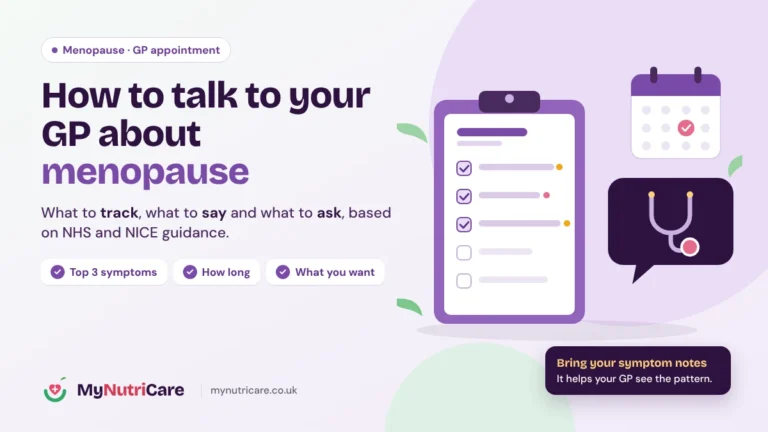
Because NICE asks GPs to go on your symptoms and periods, the most useful thing you can bring is a clear record of both:
- the first day of each period, how long it lasts and whether it is lighter or heavier than usual
- which symptoms you have, how often, and how much they affect sleep, work and home life
- any contraception, medicines or supplements you take
- the one or two things you most want help with
Keeping that going long enough to see a pattern, and turning it into a summary your GP can read in a minute, is the hard part. That is what our tracking course is built for.
Want help putting it all together?
These courses turn this guide into something you can use: a diary to spot your pattern, and a plan for the appointment. They do not diagnose or treat anything; they help you get more out of the help that is available. Browse all our menopause courses.
Understanding Perimenopause
The signs in plain English, a cycle and symptom diary, and a GP prep sheet. The best place to start if you are asking "am I perimenopausal?"
Menopause Symptom Tracking and GP Appointment Prep
8 weeks of tracking turned into a GP conversation, with a script, questions to ask and a readiness check.
Complete Menopause Guide
Every stage in one place, with a symptom tracker, a GP appointment summary and who to ask for help.
Related guides
- Your menopause GP appointment: what to bring and what to ask.
- HRT explained: types, benefits and risks, in NHS terms.
- Hot flushes and night sweats: triggers and practical ways to cope.
- Menopause, mood and anxiety: what is normal and when to get support.
Questions women ask
What are the first signs of perimenopause?
The NHS says a change in your periods is often the first sign: more or less often, or heavier or lighter. Hot flushes, night sweats, poor sleep, mood changes and memory problems are other common signs.
What age does perimenopause start in the UK?
The NHS says menopause usually happens between 45 and 55, and NICE gives the UK average as 51. Perimenopause comes before this, so early signs often appear in your 40s, though it can start earlier.
How long does perimenopause last?
There is no fixed length. The NHS says menopause symptoms usually last 7 to 9 years, sometimes longer. NICE says symptoms typically last about 4 years after the last period, and up to 12 years in about 1 in 10 women.
Can I get pregnant during perimenopause?
Yes. The NHS advises using contraception for 2 years after your last period if you are 40 to 49, or for 1 year if you are 50 or over. HRT is not a form of contraception.
Do I need a blood test to know if I am perimenopausal?
Usually not if you are over 45. NICE says GPs should diagnose perimenopause in otherwise healthy women over 45 from hot flushes or night sweats and irregular periods, without lab tests. An FSH blood test may be considered if you are 40 to 45 with symptoms, or under 40.
Are home perimenopause tests worth it?
Home kits usually measure FSH. NICE does not use lab tests to diagnose perimenopause over 45, and never diagnoses premature ovarian insufficiency from a single blood test. Whatever the result, talk to your GP.
Can perimenopause start in your 30s?
It can happen earlier than usual. The NHS calls menopause before 40 premature menopause, and NICE says premature ovarian insufficiency affects about 1 in 100 women. If you are under 40 and your periods become irregular or stop, see your GP. You can browse every course and guide on the My Nutri Care home page.
Sources
- NHS: What are menopause and perimenopause? (last reviewed 19 May 2026)
- NHS: Menopause and perimenopause symptoms (last reviewed 19 May 2026)
- NHS: Treatment for menopause and perimenopause (last reviewed 19 May 2026)
- NHS: Things you can do for menopause and perimenopause (last reviewed 19 May 2026)
- NHS: Early or premature menopause (last reviewed 11 March 2025)
- NICE NG23: Menopause: identification and management, recommendations
- NICE NG23: Context
- NICE NG23: Information for the public
This article is general information based on UK public health guidance. It is not medical advice and cannot tell you whether you are perimenopausal. If you have symptoms, are under 45, or notice heavier bleeding or bleeding after menopause, speak to your GP or pharmacist.