Powdered formula is not sterile, so the way you make up each bottle matters. Here is the exact NHS order, why the water has to be 70°C, the common slips that cause problems, and what to do at night or when you are out.

Last reviewed 12 October 2026 · Checked against NHS guidance · 12 min read
The short answer
Boil at least 1 litre of fresh tap water, then leave it in the kettle for no more than 30 minutes so it stays at 70°C or above. Clean your surface and wash your hands. Pour the hot water into a sterilised bottle first, then add the exact number of levelled scoops using the scoop from that pack. Cap, shake, cool under a cold tap and test on the inside of your wrist: it should feel warm or cool, not hot. Make each feed fresh and throw away whatever your baby leaves.
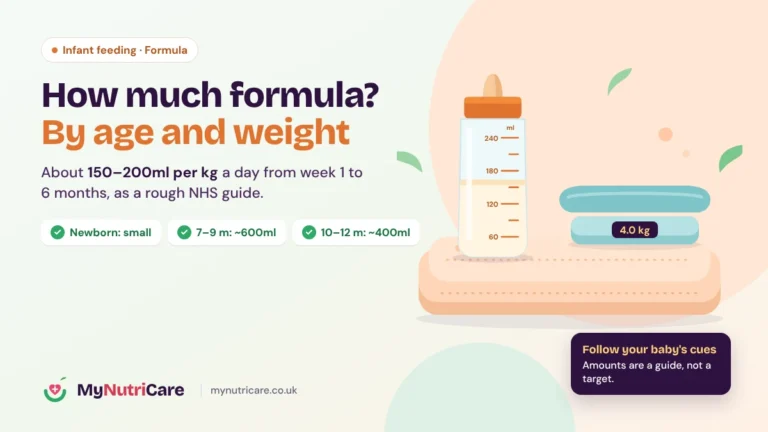
This guide covers one job: getting each bottle of powdered formula made up safely. How much your baby needs at each age is a separate question, answered in our guide to how much formula by age. When your baby starts solids at around 6 months, first infant formula stays their main drink, and our guide to when to start weaning explains how food fits alongside it.
Before you start: the water and the kit
The water
- Fresh from the cold tap, every time. Fill the kettle with at least 1 litre. Do not use water that has been boiled before.
- No artificially softened water. The NHS lists this alongside re-boiled water as water not to use.
- Bottled water is not usually recommended. It is not sterile and may contain too much salt (sodium) or sulphate. In rare situations, such as when drinking water is unavailable or has been contaminated, you can use it, following the same steps and any extra advice from the Food Standards Agency or the UK Health Security Agency.
The kit
The NHS list is short: bottles with teats and caps, brushes for cleaning bottles and teats, sterilising equipment (such as a cold-water, microwave or steam steriliser), and either formula powder or ready-to-feed liquid formula. A slower-flow teat is generally recommended for newborns, moving to a faster flow as your baby grows, led by your baby.
Which formula? The NHS says first infant formula is suitable from birth and should always be the first one you give. It does not matter which brand you choose, as all infant formula sold in the UK must meet the same standards, and there is no need for follow-on formula.
How to make up a formula feed: the 13 NHS steps
This is the order the NHS gives for making up powdered formula by hand. The three highlighted steps carry the key safety details: the 30-minute window, water before powder, and exact, levelled scoops.
Get the water ready
- Fill the kettle with at least 1 litre of fresh tap water. Do not use water that has already been boiled.
- Boil the water, then leave it to cool in the kettle for no more than 30 minutes, so that it stays at 70°C or above.
Prepare the space
- Clean and disinfect the surface you are going to use.
- Wash your hands thoroughly.
- If you use a cold-water steriliser, shake off excess solution from the bottle and teat, or rinse them with cooled boiled water from the kettle, not tap water.
- Stand the bottle on the cleaned, disinfected surface. Best Start in Life adds: keep the teat and cap on the upturned lid of the steriliser, not on the worktop.
Mix the feed
- Following the manufacturer's instructions, pour the water in first, while it is still hot, before adding the powder. Check the water level is correct.
- Loosely fill the scoop with powder and level it off with the flat edge of a clean, dry knife or the leveller provided. Add only the number of scoops the instructions give, using only the scoop that comes with that formula.
- Hold the teat by its edge, push it into the retaining ring, check it is secure, then screw the ring tightly onto the bottle.
- Cover the teat with the cap and shake the bottle until the powder dissolves.
Cool, check and feed
- Cool the bottle, with the lid on, under cold running water. Best Start in Life suggests holding the bottom half under the tap and moving it about so it cools evenly.
- Test the temperature on the inside of your wrist. It should be body temperature: warm or cool, but not hot.
- After the feed, throw away any formula left in the bottle.
Follow the instructions on your formula pack closely: the amount of water and powder varies between products. For how many millilitres to make at each age, see how much formula by age.
Why 70°C matters (and why 30 minutes)
The NHS is clear that even sealed tins and packets of powdered formula can contain bacteria. Water at 70°C or more will kill any harmful bacteria. That is why the hot water goes in first and the powder second: the powder meets water that is still hot enough to deal with it.
The 30-minute limit is simply how long boiled water in a kettle can be left while still staying at 70°C or above. Leave it longer and the water may have cooled too far. The 70°C rule itself is precautionary advice that the Chief Medical Officer and the Director for Public Health Nursing restated in 2013, to minimise the microbiological risk to babies, and the NHS still gives it today.
Bacteria also explain the other rules. They multiply quickly at room temperature, and a fridge slows them down but does not stop them. So the NHS advice is to make up feeds one at a time, as your baby needs them.
Common mistakes when making up formula
Each of these comes straight from NHS advice, with the reason behind it.
| Mistake | Why it matters | Do this instead |
|---|---|---|
| Re-boiling water left in the kettle | The NHS says not to use water that has been boiled before | Empty the kettle and boil fresh tap water |
| Leaving boiled water longer than 30 minutes | It may drop below 70°C, which is needed to kill bacteria in the powder | Make up the feed within 30 minutes of boiling |
| Powder in first, water second | The NHS order is water first, while still hot | Pour, check the level, then add scoops |
| Heaped, packed or extra scoops | Too much powder can cause constipation or dehydration | Loosely fill and level each scoop |
| Extra water or fewer scoops | Too little powder may not give your baby enough nourishment | Stick to the pack's ratio exactly |
| Using another brand's scoop | The NHS says to use only the scoop that comes with that formula, as amounts vary between products | Keep each scoop with its own pack |
| Adding sugar or cereal to the bottle | The NHS says not to add either | Formula and water only |
| Warming a bottle in the microwave | It can heat unevenly and burn your baby's mouth | Cool under a cold tap and test on your wrist; never microwave |
| Saving the leftovers for later | Leftover feed should be thrown away | Bin what is left after each feed |
| Rinsing a sterilised bottle under the tap | The NHS says rinse with cooled boiled water from the kettle, not tap water | Shake off solution or rinse with kettle water |
Night feed and out-and-about planner
Pick your situation to see the NHS-safe way to do it. Nothing is saved.
Choose a situation above
Your safe method will appear here in a few lines.
A quick guide based on NHS advice. Formula Feeding Basics covers making up feeds, sterilising and amounts by age, with a simple feeding log.
Can you make formula in advance?
The NHS advice is to avoid it where you can: to reduce the risk of infection, make up feeds one at a time, as your baby needs them. Even in the fridge, bacteria can still survive and multiply, just more slowly. If you have no choice but to store a feed, NHS Best Start in Life says to speak to your health visitor about the best way to do it.
The main nhs.uk and Best Start in Life pages do not give fridge or cool-bag times. The timings below come from NHS 111 Wales, apart from the 2-hour room-temperature rule, which Best Start in Life also gives.
Sometimes a made-up feed has to travel, for example to a nursery. NHS 111 Wales sets out how: make it up at home with water at 70°C or above, cool it, then put it in the back of the fridge for at least 1 hour before you leave. Take it out just before you go and carry it in a cool bag with an ice pack. Once made up, NHS 111 Wales says a feed should be used within these limits:
Whichever applies, the leftover rule does not change: anything your baby does not finish goes in the bin. If you also give expressed breast milk, its storage times are different; see our guide to breast milk storage in the UK.
Making up formula when you are out
For a trip out, NHS 111 Wales suggests making the feed fresh when your baby needs it, rather than carrying a made-up bottle. Pack three things: For a closer look, see our guide: Formula Feeding Amounts.
- a measured amount of formula powder in a small, clean, dry container
- a vacuum flask of water that has just been boiled (the flask does not need sterilising, but it should be clean)
- an empty sterilised bottle with the cap and retaining ring on
If the flask is full and sealed, the water will stay above 70°C for several hours. The water must still be hot when you use it, to destroy any bacteria in the powder. Then make up the feed as usual and cool the bottle, lid on, under cold running water before feeding.
The simpler option is a carton of ready-to-feed liquid formula, which NHS 111 Wales also suggests for when you are away from home. You will still need a sterilised bottle and teat, because the NHS says to sterilise all feeding equipment until your baby is at least 12 months old.
Night feeds: the same rules, fewer steps to fumble
There is no separate NHS method for night feeds. Every feed, including at 3am, is made up fresh with water at 70°C or above. What helps is setting things up so the safe way is also the easy way:
- Before bed, have sterilised bottles ready, left in the steriliser until you need them, and the formula and scoop to hand.
- When your baby wakes, boil fresh tap water and use it within 30 minutes. A ready-to-feed carton skips the mixing altogether.
- Prep machines are only an option if the water they dispense is at least 70°C when mixed with the powder (see below).
- While feeding, the NHS says never leave your baby alone to feed with a propped-up bottle, and let them decide how much they want. Do not worry if they do not finish it. A propped-up bottle is a choking risk; our guide to the signs of gagging and choking explains what to look for.
Formula preparation machines
The NHS does not tell parents to avoid prep machines, but it does set one condition. The water that comes out of the machine must be at least 70°C when it is mixed with the formula powder.
- Follow the manufacturer's instructions.
- Check the temperature yourself with a digital food thermometer.
- If the water is below 70°C, stop using the machine and make up feeds by hand.
- A faulty machine can be reported to the manufacturer, your local Trading Standards department or Citizens Advice.
Ready-to-feed vs powdered formula
Both are first infant formula. What changes is how much preparation is involved. The NHS notes that ready-to-feed liquid can be convenient but tends to be more expensive.
| Powdered formula | Ready-to-feed liquid | |
|---|---|---|
| Sterile? | No. Even sealed tins and packets can contain bacteria | Sterile until opened |
| Preparation | The full 13 steps, with water at 70°C or above | No mixing, but bottles and teats still need sterilising |
| Storing | Make each feed fresh. Throw away leftovers after a feed, and any made-up formula left at room temperature for over 2 hours | Once opened, store on the top shelf at the back of the fridge, cut corner turned down, for no longer than 24 hours |
| Out and about | Flask of just-boiled water and pre-measured powder | A carton is the easy option |
Sterilising basics
The NHS says to sterilise all feeding equipment, including bottles and teats, until your baby is at least 12 months old. Sterilising only works on clean equipment, so cleaning comes first.
Clean first
Wash bottles and teats in hot, soapy water as soon as you can after a feed, using a bottle brush and a small teat brush (you can turn teats inside out). Do not use salt to clean teats. Check for cracks or damage, then rinse everything in clean, cold running water. A dishwasher will clean feeding equipment, but it will not sterilise it.
Then choose one of three methods
Cold-water solution
At least 30 minutes- Change the solution every 24 hours
- No air bubbles trapped in bottles or teats
- Use the floating cover to keep everything under
Steam
Electric or microwave steriliser- Follow the manufacturer's instructions
- Put bottle and teat openings facing down
Boiling
At least 10 minutes- Keep everything under the surface
- Never leave the pan unattended
- Teats wear out faster: check for tears
Leave bottles and teats in the steriliser or pan until you need them. If you take them out, put the teats and lids on straight away, wash and dry your hands first or use sterile tongs, and assemble bottles on a clean, disinfected surface.
Want it all on one page? Formula Feeding Basics includes a full sterilising checklist alongside making up feeds and amounts by age.
Speak to your midwife, health visitor or GP if...
you need to store made-up feeds regularly, you are unsure which formula to use or think one disagrees with your baby, your baby was born early or has a health condition, or your baby seems unwell after feeds. The NHS says there is no evidence that switching formula does any good or harm, so ask before changing.
Make formula feeding feel routine
Our infant feeding courses turn this guide into a plan you can follow, without the late-night searching.
Formula Feeding Basics
Making up feeds, a full sterilising checklist, amounts by age and a simple feeding log.
First 6 Weeks With Baby
A calm guide to the newborn weeks, when feeding routines are still taking shape.
Combination Feeding Education
Mixing breast and bottle: plan your feeds, protect your milk supply and try paced bottle feeding.
Related guides
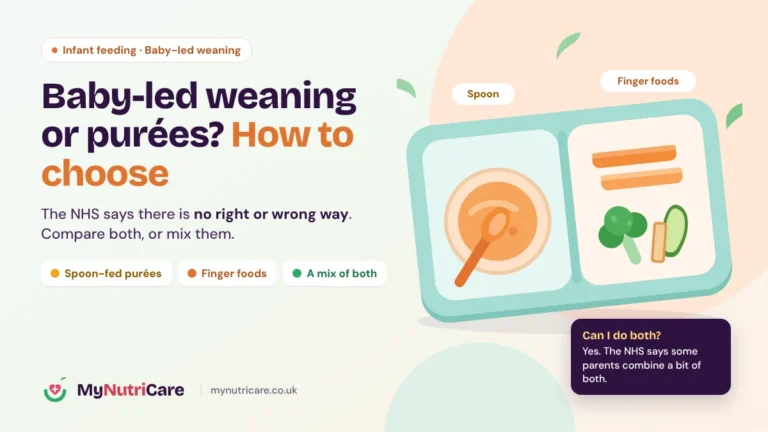
- Purées or finger foods?: baby-led weaning vs spoon feeding.
- Birth plan: feeding preferences: what to tell staff on the day.
- Find the right course: match a course to your goal.
Questions parents ask
Why does formula need to be made with water at 70°C?
Powdered formula is not sterile: even sealed tins and packets can contain bacteria. The NHS says water at 70°C or more will kill any harmful bacteria, which is why you leave boiled water no more than 30 minutes and add the water before the powder.
Can you make formula bottles in advance?
The NHS advises making up feeds one at a time, as your baby needs them, because bacteria can still multiply in the fridge. If you have no choice but to store a feed, speak to your health visitor. NHS 111 Wales says a made-up feed kept in the fridge should be used within 24 hours, within 4 hours in a cool bag with an ice pack, and within 2 hours at room temperature.
Do you put water or powder in the bottle first?
Water first. The NHS says to pour in the hot water while it is still hot, check the level, then add the exact number of levelled scoops using the scoop that comes with that formula.
Can I use bottled water to make up formula?
It is not usually recommended, because bottled water is not sterile and may contain too much sodium or sulphate. In rare cases, such as when tap water is unavailable or contaminated, you can use it, made up with the same steps.
How long can a made-up formula bottle stay out?
NHS Best Start in Life says to throw away formula that has been at room temperature for over 2 hours. Anything left in the bottle after a feed should be thrown away straight away.
Can I warm a formula bottle in the microwave?
No. The NHS says never warm formula in a microwave, as it can heat the feed unevenly and burn your baby's mouth. Always test the temperature on the inside of your wrist before feeding.
How long do I need to sterilise baby bottles?
Until your baby is at least 12 months old. Clean bottles and teats in hot, soapy water first, then sterilise with cold-water solution, steam or boiling. A dishwasher cleans but does not sterilise. You can browse every course and guide on the My Nutri Care home page.
Sources
- NHS: How to make up baby formula (last reviewed 31 August 2023)
- NHS Best Start in Life: How to make up a feed
- NHS Best Start in Life: How to use formula
- NHS Best Start in Life: Things you need for formula feeding
- NHS Best Start in Life: How to sterilise equipment
- NHS: Sterilising baby bottles (last reviewed 24 February 2023)
- NHS: Bottle feeding advice (last reviewed 2 April 2024)
- NHS: Types of formula (last reviewed 6 April 2023)
- NHS: Can I use bottled water to make up baby formula?
- NHS 111 Wales: Bottle feeding, common questions
- GOV.UK: Advice on preparation of formula milks restated (2013)
This article is general information based on UK public health guidance. It is not medical advice. If your baby was born prematurely, has a health condition or allergy, or you have questions about your own baby's feeding, speak to your midwife, health visitor, GP or pharmacist.