Newborns start with small amounts, and from the end of the first week a rough NHS guide is 150 to 200ml per kg of body weight a day. Here is where that number comes from, how to use it without watching the bottle, and how amounts change once solids begin.

Last reviewed 12 October 2026 · Checked against NHS guidance · 13 min read
The short answer
Newborns need quite small amounts of formula at first. By the end of their first week, most need around 150 to 200ml per kg of their weight a day until 6 months (NHS 111 Wales). With solids, NHS guidance suggests around 600ml a day at 7 to 9 months and around 400ml at 10 to 12 months. All are guides, not targets: feed to your baby's hunger and fullness cues, and judge progress by weight gain and wet and dirty nappies.
Most charts online come from formula brands, and they can make a bottle feel like a test. NHS guidance has no fixed amount per feed and no timetable. This guide sets out the numbers the NHS does give, why your baby's cues matter more, and what changes when your baby starts solid foods at around 6 months (our guide to when to start weaning covers the readiness signs).
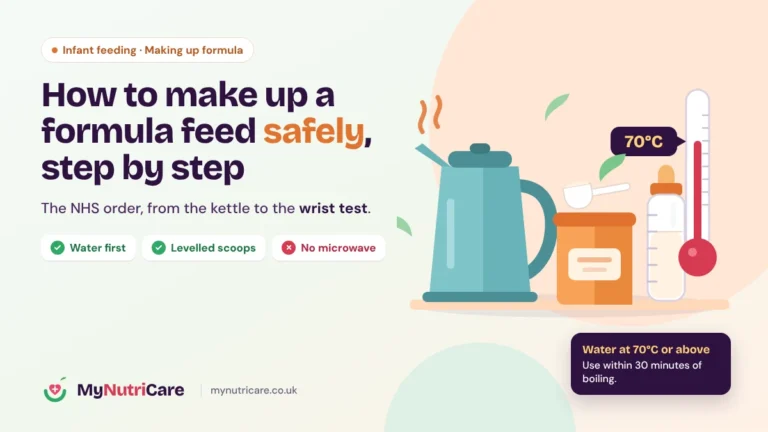
If you are still getting to grips with preparing bottles, start with how to make up a formula feed safely. This article is about how much, not how to mix it.
- First daysQuite small amountsNo figure is given. Babies feed little and often and may not finish their bottle.
- End of week 1 to 6 monthsAbout 150 to 200ml per kg a daySpread across all feeds in 24 hours. Amounts vary from baby to baby. Source: NHS 111 Wales
- 7 to 9 monthsAround 600ml a dayAlongside solid foods. The NHS says "just use this as a guide". Source: NHS Best Start in Life
- 10 to 12 monthsAround 400ml a dayOften about 3 milk feeds a day by now. Source: NHS Best Start in Life
- From 12 monthsNo formula neededWhole or semi-skimmed pasteurised cows' milk can become a main drink. Source: NHS
Why the NHS puts your baby's cues before the numbers
UK health professionals recommend responsive feeding, also called feeding on demand. That means:
- No schedule. You do not need a feeding schedule. Most babies settle into their own routine, but they vary in how often they feed and how much they drink.
- Little and often is normal. Babies tend to feed little and often, so they may not finish their bottle.
- A bigger feed will not buy you a longer gap. A big feed does not mean your baby will go longer before the next one.
Feeding when your baby is hungry, rather than to a schedule, can also reduce the risk of overfeeding. So a smaller feed followed by a bigger one is usually your baby regulating their own intake.
NHS 111 Wales adds that amounts may change if your baby is unwell, teething or having a growth spurt. In a growth spurt they may cluster feed for a few days. You can cluster feed formula, the NHS says, but keep watching for signs they have had enough so you do not overfeed.
Hot weather? Formula-fed babies under 6 months may need small sips of cooled boiled water during hot weather, as well as their milk.
The first days: why newborn amounts are small
The NHS gives no millilitre figure for the first days, only that newborns need quite small amounts to start with and that this varies between babies. Also normal in this stretch:
- Some early weight loss. It is normal to lose some weight in the first few days. Most babies are back at or above birthweight by 3 weeks.
- Meconium first. For the first few days your baby passes a dark, sticky poo called meconium. After the first week, poo is usually pale yellow or yellowish brown.
- Night feeds. Your baby is likely to need night feeds for at least the first few months. These reduce as your baby gets older.
The per-kg guide, explained (and its limits)
The one weight-based NHS figure is on NHS 111 Wales (last updated April 2021): by the end of their first week, most babies need around 150 to 200ml per kilo of their weight a day until 6 months. The current NHS England page gives no figure and simply says to feed when your baby shows they want it. For a 4kg baby:
A rough guide across all feeds in 24 hours, not a target and not a per-feed amount.
Keep three things in mind:
- It is a daily total, not a bottle size. The NHS gives no feeds per day or ml per feed, so do not divide it into "correct" bottles.
- It is a wide range on purpose. The top is a third higher than the bottom, and babies at either end can be perfectly well.
- Weight gain and nappies outrank the sum. The NHS says weight gain and wet and dirty nappies tell you whether your baby is getting enough. If those are on track, the maths does not matter.
Rough daily range calculator
Enter your baby's weight to see the NHS 150 to 200ml per kg range as a daily total. Nothing is saved.
How old is your baby?
Your baby's latest weight
Choose an age and enter a weight
Your baby's rough daily range will appear here.
A rough guide only, for babies born at term. The Formula Feeding Basics course covers amounts by age with a simple feeding log.
Hunger cues and fullness cues
Learning your baby's signals is the most useful skill in formula feeding. The NHS says to feed your baby when they show early signs of hunger, before they cry.
Also from the NHS:
- Crying is the last sign. Try to feed before your baby cries, because crying is a late sign of hunger.
- Not every cry is hunger. If your baby has been fed recently, hunger is unlikely to be the cause of their crying. Try soothing them first: a cuddle and some skin-to-skin contact may help.
- Pauses are normal. Babies usually take small amounts of milk, stop for a rest, then take more. A pause is not always the end of the feed.
Responsive (paced) bottle feeding, step by step
Paced feeding is responsive feeding with a bottle: it slows the flow so your baby can notice when they are full. The NHS steps:
- Watch for early hunger cuesOffer the bottle when you see rooting, hand sucking or mouth movements, before crying.
- Hold your baby close and semi-uprightSupport their head. Invite them to open their mouth by gently rubbing the teat against their top lip.
- Keep the bottle nearly horizontalTip it just slightly, so milk does not flow too fast and your baby takes in less air. If the teat flattens, gently pull the corner of their mouth to release the vacuum.
- Pause when you see a break cueIf your baby splays their fingers, spills milk, stops sucking, turns away or pushes the bottle, gently remove the teat or lower the bottle to stop the flow.
- Allow breaks and wind as neededShort pauses are normal. Afterwards, hold them upright and gently rub or pat their back to bring up wind.
Three NHS safety rules for every feed
- Never leave your baby alone with a propped-up bottle, as they may choke.
- Never feed your baby while they are in a sling or carrier. Take them out first.
- Never force your baby to finish a feed. The NHS says this will be distressing and can mean your baby is overfed.
Throw away any formula left in the bottle after a feed and make up feeds one at a time, as your baby needs them. Bacteria multiply very fast at room temperature, so do not save leftovers for the next feed. The full preparation and storage rules are in our step-by-step formula guide.
Is my baby getting enough formula?
The NHS answer has nothing to do with millilitres: your baby's weight gain and wet and dirty nappies tell you.
Reading the red book
Your baby's weight is plotted on the growth charts in their personal child health record, known as the red book. The curved centile lines show average gain for babies of different ages. The NHS explains that a baby's measurements may go up or down by 1 centile line, but it is less common for them to cross 2. If that happens, talk to your health visitor.
After the early checks, the NHS suggests weighing no more than monthly up to 6 months, then every 2 months to 12 months. Illness can slow weight gain for a while; it usually recovers within 2 to 3 weeks. For a closer look, see our guide: Starting Solids in the UK.
Overfeeding and underfeeding: what to watch for
With a bottle it is easy to give more than a baby needs, and just as easy to worry about too little. What the NHS pages flag:
Signs you may be pushing too much
- Encouraging your baby to finish the bottle after they show fullness cues
- Feeding to a schedule rather than to hunger signs
- Milk flowing too fast: keep the bottle nearly horizontal, just slightly tipped
- Adding extra powder, sugar or cereal to the bottle
Signs to check with a professional
- Fewer wet nappies than usual
- Not gaining weight, or losing weight
- Under 8 weeks and no poo for 2 to 3 days
- Refusing feeds
Bringing up a little milk during or shortly after a feed (reflux) is common under age 1. The NHS suggests burping your baby regularly during feeds and holding them upright during feeding and for as long as possible afterwards.
Myths that push amounts up
A record of feeds and nappies makes health visitor chats easier; the NHS suggests one if reflux is a worry. Formula Feeding Basics includes a simple feeding log alongside amounts by age.
From 6 months: how milk amounts change once solids start
The per-kg guide stops at 6 months, when food joins milk (see when to start weaning in the UK). First infant formula stays the main drink for the whole first year.
- 7 to 9 months: formula-fed babies may need around 600ml of milk a day. The NHS adds: "just use this as a guide".
- 10 to 12 months: your baby may be down to about 3 milk feeds a day, and if they have first infant formula they may need around 400ml a day, again as a guide.
- Milk after food: at 7 to 9 months the NHS suggests offering milk feeds after solids, and not forcing your baby to finish the bottle.
- Between meals: babies under 12 months do not need snacks. If your baby seems hungry between meals, the NHS says to offer extra milk feeds instead.
- Water: from around 6 months, offer sips of water from an open or free-flow cup with meals. It does not replace milk feeds.
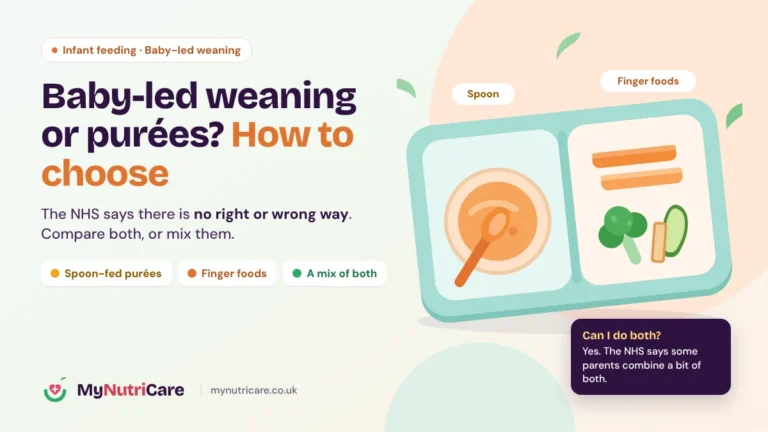
Milk does not need to fall on a set date. Keep reading the same cues, whether you choose purées or baby-led weaning.
The 500ml vitamin rule
The NHS says babies having more than 500ml (about a pint) of infant formula a day should not be given vitamin supplements, because formula is already fortified with vitamins A, C and D. Below that, daily vitamin A, C and D drops are recommended from 6 months to 5 years, and breastfed babies need daily vitamin D from birth, so if you combination feed, ask your health visitor. You may be entitled to free Healthy Start vitamin drops, and in some areas they are free to all families.
At 12 months: cows' milk, not follow-on formula
Formula marketing suggests "next stage" milks. The NHS does not:
- First infant formula is all your baby needs. Unless a midwife, health visitor or GP suggests otherwise, first infant formula is the only formula your baby needs, and they can drink it throughout their first year.
- Follow-on formula is not needed. It should never be given to babies under 6 months, and research shows switching to it at 6 months has no benefits for your baby.
- Growing-up, toddler and goodnight milks are not needed. Formula milks are not needed once your baby is 12 months old, and goodnight milk is not suitable for babies under 6 months.
- Cows' milk from 1 year. Whole or semi-skimmed pasteurised cows' milk can become a main drink at 1 (before that, only in cooking or food from around 6 months). Skimmed and 1% milk wait until 5.
- Bottle to cup. The NHS suggests introducing a cup from around 6 months, and says feeding from a bottle should be discouraged once your baby is 1.
Combining breast and bottle? Amounts look different because breastfeeds count too. Combination Feeding Education walks through planning feeds, protecting your milk supply and paced bottle feeding. If you express for bottle feeds, our guide to breast milk storage times covers the fridge and freezer rules.
When to talk to your health visitor, GP or NHS 111
Speak to your midwife or health visitor if you are worried about how much your baby is getting, their weight gain, or crossing 2 centile lines. Their number is in the red book.
Speak to your health visitor or GP if your baby is not gaining weight or is losing weight, or has reflux that is not improving. Constant crying can be due to a cows' milk allergy: talk to your GP before changing your baby's formula. Under 8 weeks with no poo for 2 to 3 days? Contact your midwife, health visitor or GP.
Get an urgent GP appointment or call 111 if your baby is refusing to feed, keeps being sick and cannot keep fluid down, is projectile vomiting, has green or yellow vomit or blood in their vomit, or shows signs of dehydration: fewer wet nappies, few or no tears, a sunken soft spot on their head, sunken eyes, or being drowsy or irritable. Call 999 if they are hard to wake, have blue, grey or pale skin or lips, or are struggling to breathe.
Feel confident at every feed
Formula Feeding Basics
Making up feeds, sterilising, amounts by age and a simple feeding log, all checked against NHS guidance.
Combination Feeding Education
Plan your feeds, protect your milk supply and learn paced bottle feeding when you mix breast and bottle.
Related guides
- Is it gagging or choking?: signs and NHS first aid for babies.
- Your birth plan, including feeding: how to write a UK birth plan.
- Not sure which course to take?: our course guide by goal.
Questions parents ask
How much formula should a newborn drink?
Newborns need quite small amounts of formula to start with. By the end of their first week, most need around 150 to 200ml per kg of their weight a day until 6 months, according to NHS 111 Wales. Feed to hunger cues rather than a set amount.
How much formula does a baby need by age?
The NHS gives small amounts for newborns, around 150 to 200ml per kg a day from the end of week 1 to 6 months, around 600ml a day at 7 to 9 months and around 400ml at 10 to 12 months. All are guides, not targets. From 12 months formula is not needed.
How do I know if my baby is getting enough formula?
Weight gain and nappies. Expect at least 6 wet nappies a day, heavy with clear or pale yellow urine, and at least 1 soft poo a day. Most babies are back to birthweight by 3 weeks.
Can you overfeed a formula-fed baby?
Yes. The NHS says never force your baby to finish a feed, as this can mean they are overfed. Feeding to hunger rather than a schedule reduces the risk. Pause when your baby turns away, stops sucking or pushes the bottle away.
Should my baby finish their bottle?
No. Babies tend to feed little and often and may not finish their bottle, and the NHS says not to worry. Throw away any formula left after a feed.
Do I need follow-on milk at 6 months?
No. First infant formula is the only formula your baby needs in their first year unless a midwife, health visitor or GP suggests otherwise. The NHS says switching to follow-on formula at 6 months has no benefits.
When can my baby switch from formula to cows' milk?
From 1 year, whole or semi-skimmed pasteurised cows' milk can become the main drink and formula is no longer needed. Before 12 months, cows' milk is for cooking or mixing into food only. You can browse every course and guide on the My Nutri Care home page.
Sources
- NHS Best Start in Life: How to bottle feed your baby
- NHS Best Start in Life: Feeding on demand
- NHS Best Start in Life: Cluster feeding
- NHS: Formula milk: common questions (last reviewed 8 September 2023)
- NHS 111 Wales: Infant formula: common questions (last updated 19 April 2021)
- NHS: Bottle feeding advice (last reviewed 2 April 2024)
- NHS: Types of formula (last reviewed 6 April 2023)
- NHS Best Start in Life: What to feed your baby from 7 to 9 months
- NHS Best Start in Life: What to feed your baby from 10 to 12 months
- NHS: Drinks and cups for babies and young children (last reviewed 5 October 2022)
- NHS Best Start in Life: Baby vitamins
- NHS: Baby height and weight (last reviewed 20 September 2023)
- NHS Best Start in Life: Reflux and bottle feeding
- NHS: Reflux in babies (last reviewed 10 June 2025)
- NHS: Dehydration
- NHS: How to make up baby formula (last reviewed 31 August 2023)
- NHS Best Start in Life: Constipation and bottle feeding
- NHS Best Start in Life: Colic and bottle feeding
- NHS: Vitamins for children (last reviewed 30 May 2024)
This article is general information based on UK public health guidance. It is not medical advice. If your baby was born prematurely, has a health condition or allergy, is on a special formula, or you have questions about your own baby, speak to your midwife, health visitor, GP or pharmacist.