The UK advice is to start solid foods at around 6 months, when your baby shows three clear signs together. Here is what those signs look like, what gets mistaken for them, and what the NHS says about 4 months, premature babies and allergens.

Last reviewed 12 October 2026 · Checked against NHS guidance · 16 min read
The short answer
In the UK, the NHS and the government's nutrition advisers (SACN) say to start solid foods at around 6 months, alongside breast milk or first infant formula. Your baby is ready when three signs appear together: they can stay sitting and hold their head steady, they can look at food, pick it up and put it in their mouth by themselves, and they swallow food rather than spit it out. Chewing fists, waking at night and wanting extra milk are normal and are not signs of readiness. If your baby was born early, ask your health visitor or GP when to start.
This guide is the starting point for our infant feeding courses. Every point below comes from current NHS and SACN guidance.
Why around 6 months, and not earlier?
In its 2018 report, Feeding in the first year of life, the Scientific Advisory Committee on Nutrition (SACN) recommended that babies are not introduced to solid foods until around 6 months of age, with exclusive breastfeeding for around the first six months. The NHS follows that advice.
The NHS gives three reasons for waiting:
- Milk is enough until then. Breast milk or first infant formula provides the energy and nutrients your baby needs until around 6 months.
- Protection from infection. Feeding only breast milk up to around 6 months helps protect your baby against illness and infections.
- Your baby needs time to develop. Waiting gives your baby time to develop so they can cope fully with solid foods. By around 6 months they are better able to feed themselves and to move food around their mouth, chew and swallow it.
The 3 signs your baby is ready for solid foods
The NHS lists three signs which, when they appear together from around 6 months, show that your baby is ready for their first solid foods. One sign on its own is not enough.
Is my baby ready? A 30-second check
Answer four quick questions based on the NHS readiness signs. Nothing is saved.
How old is your baby?
Can they stay sitting up and hold their head steady?
Can they look at food, pick it up and put it in their mouth by themselves?
Do they swallow food rather than spit it back out?Not offered food yet? Choose "Not tried yet".
Answer the questions above
Your result will appear here as you go.
A quick guide, not a diagnosis. The Starting Solid Foods course takes you from these signs to your first fortnight of foods.
Signs often mistaken for readiness
The NHS names three behaviours that are often misread. All are normal and do not necessarily mean your baby is ready for solid food.
Weaning at 4 months: what the NHS says
Some shop-bought baby foods are labelled as suitable from 4 months, which causes a lot of confusion. The NHS is direct about this: wait until your baby is around 6 months, even if labels say a product is suitable from 4 months.
Thinking about starting before 6 months?
Talk to your health visitor or GP first. Do not add anything to a bottle: the NHS says to put nothing, such as sugar or cereals, in a bottle other than breast milk or infant formula. Babies do not need baby rice to help them move to solid foods or to sleep better.
Premature babies: a different timeline
If your baby was born prematurely, the general "around 6 months" advice may not apply in the same way. The NHS advice is simple: ask your health visitor or GP when to start introducing solid foods. The readiness signs are still worth knowing, so take your answers from the check above to your appointment.
Weaning at 6 months: what the first days look like
The NHS advice for the first days is reassuringly low-pressure:
- Start small. At first your baby only needs a small amount of solid food, once a day. You do not need to worry about how much they eat.
- Pick a calm time. Choose a time that suits you both, when you are not rushed and your baby is not overtired. Offer food before their usual milk feed, as they may not be interested if they are full.
- Let your baby lead on amount. Never force them to eat. Stop when they show they have had enough, such as firmly closing their mouth or turning their head away.
- Milk feeds carry on. Keep offering breast milk or first infant formula on demand. It still gives most of their energy and nutrients.
What to offer first
The NHS suggests starting with single vegetables and fruits, mashed or as soft-cooked sticks, such as parsnip, broccoli, potato, yam, sweet potato, carrot, apple or pear. Include vegetables that are not sweet, such as broccoli, cauliflower and spinach: offering a range of tastes can help prevent fussy eating later. Then gradually add more variety, including starchy foods, protein foods and full-fat dairy such as plain unsweetened yoghurt.
It can take 10 tries or more before your baby accepts a new food or texture, so keep offering it. Shop-bought pouches and jars are for occasional use: squeeze pouches onto a spoon rather than letting your baby suck from them, which can increase the risk of tooth decay.
Purées or finger foods?
Either is fine, or a mix of both, and our comparison of baby-led weaning and purées helps you choose. The NHS advises moving on from purées to mashed, lumpy or finger foods as soon as your baby can manage them, because this builds chewing and swallowing skills.
Baby-led weaning, where you offer only finger foods and your baby feeds themselves, is one option. The NHS says it carries no more risk of choking than spoon feeding. Finger foods should be about the size of your finger, break up easily and are easy to grip, such as soft-cooked vegetables, soft fruit, avocado, pasta, boneless fish and boiled egg.
Want a day-by-day plan? Starting Solid Foods sets out your first fortnight of foods, with a baby food diary. Prefer finger foods? Baby-Led Weaning Education covers safe shapes and sizes, with a first foods tracker.
Building up to 3 meals a day
The NHS describes a gradual build-up over the next few months, with milk still central:
| Age | Meals | Milk feeds (NHS guide) | Textures |
|---|---|---|---|
| Around 6 months | A small amount once a day, increasing week by week | On demand | Mashed, blended or soft finger foods |
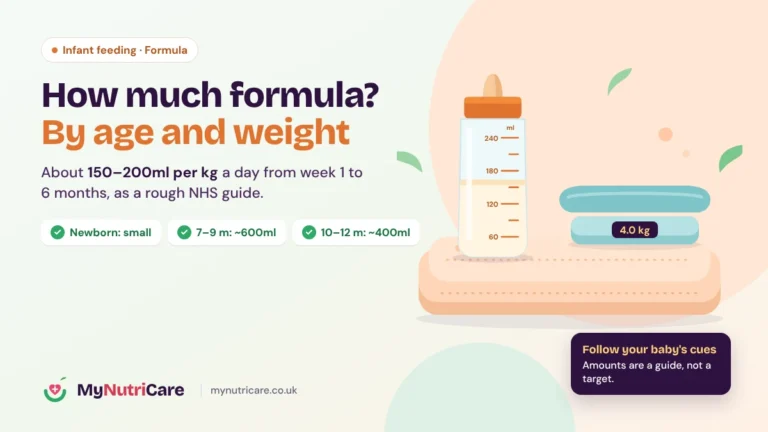
| From about 7 months | Gradually moving towards 3 meals (breakfast, lunch and tea) | Around 4 a day; formula-fed babies may need around 600ml | More mashed and lumpier foods, plus finger foods |
| From about 10 months | 3 meals a day | About 3 a day; formula-fed babies may drink around 400ml | A wider range of finger foods |
Babies under 12 months do not need snacks. If your baby seems hungry between meals, the NHS says to offer an extra milk feed instead. If you formula-feed, our guide to formula amounts at each age shows how milk feeds change as meals build up.
Make room for iron
SACN recommends introducing a wide variety of foods, including iron-containing foods, from around 6 months. The NHS suggests meat, fish, eggs, beans, pulses, tofu and fortified breakfast cereals.
Drinks: water, cups, juice and cows' milk
- Water in a cup from around 6 months. Offer sips of water with meals: an open cup or a free-flow cup without a valve helps your baby learn to sip and is better for their teeth. Tap water for babies over 6 months does not need to be boiled first.
- No juice or sugary drinks. Babies under 12 months do not need fruit juice or smoothies, which are high in sugar. Squash, fizzy drinks, flavoured milk, "baby" or herbal drinks and caffeinated drinks are not suitable either.
- Cows' milk in food, not as a drink. Cows' milk can be used in cooking or mixed into food from around 6 months, but should not be a main drink until 12 months. Unsweetened calcium-fortified plant drinks also wait until 12 months.
Introducing allergens: when and how
Older advice to hold back certain foods still circulates, but SACN says peanut and hen's egg can be introduced from around 6 months and need not be treated differently from other solid foods. Both SACN and the NHS add that deliberately leaving them out beyond 6 to 12 months may increase the risk of allergy to those same foods. For a closer look, see our guide: Baby-Led Weaning or Purées.
The NHS lists these as the foods that can trigger allergic reactions:
How the NHS says to introduce them
- From around 6 months, alongside other solid foods, not before.
- One at a time, in very small amounts, so you can spot any reaction and know which food caused it.
- In a safe form. Nuts and peanuts crushed or finely ground and mixed into food, or nut butter spread on food such as toast (never on its own); seeds crushed or ground; eggs without the red Lion stamp cooked until solid; shellfish never raw or lightly cooked.
- Keep offering them. If a food is tolerated, keep it in their usual diet: the NHS says this helps minimise the risk of allergy.
Talk to your GP or health visitor first if...
your baby already has a diagnosed food allergy or eczema, or there is a family history of food allergies, eczema, asthma or hay fever. The NHS says to take particular care, and to check with your GP or health visitor before introducing nuts if there is a family history of allergies. Do not cut out a major food such as milk on your own; your GP or health visitor may refer you to a registered dietitian.
Reactions usually happen quickly, within a few minutes of trying a new food. Signs can include swollen lips or face, a red itchy rash, worsening eczema, red, itchy or watery eyes, a runny or blocked nose, wheezing, coughing, being sick, tummy pain, diarrhoea or constipation. Anaphylaxis is a severe reaction that starts quickly and can cause breathing problems, a swollen throat or tongue, or a raised itchy rash. It is a medical emergency: call 999 and get medical help immediately.
An allergen log comes with Starting Solid Foods, and Food Allergy Awareness for Parents covers food allergies in more depth.
Gagging, choking and safe mealtimes
The NHS describes gagging as a normal reflex as your baby learns to chew and swallow solid food. Choking is different: the key clue is noise.
Gagging is loud
- Loud noise
- Skin may go red (harder to see on brown and black skin)
- Watery eyes
- Tongue pushed forward or out of the mouth
- Retching or being sick to move food forward
Choking is quiet
- Silence
- On white skin, the lips may turn blue
- On brown or black skin, the gums, inside of the lips or fingernails may look blue
If you think your baby is choking and cannot breathe properly, the NHS says to shout for help, take them out of the high chair, support their chest and chin with one hand, and give 5 sharp blows between their shoulder blades with the heel of your other hand. The NHS also points parents to baby first aid courses. We set out the signs side by side, with every NHS first-aid step, in how to tell gagging from choking.
How to lower the risk of choking
- Sit your baby upright and alert in a high chair, so they can swallow properly, and always stay with them while they eat.
- Cut small round foods such as grapes, cherries, berries, strawberries and cherry tomatoes into quarters. Cut other foods into narrow batons rather than rounds.
- Remove hard pips and stones from fruit, and all bones from meat and fish.
- Avoid hard foods such as raw carrot or apple. No whole nuts or popcorn under 5, and no whole raisins or dried fruit under 1.
- Never give peanut butter by itself, or jelly cubes, marshmallows, boiled sweets or ice cubes, which are all choking hazards.
Food hygiene
The NHS hygiene basics for weaning are to wash your hands before preparing food, keep surfaces clean, wash and peel fruit and vegetables, and let hot food cool and test it before serving.
The gagging vs choking card in Starting Solid Foods puts these signs on one page you can keep by the high chair.
Foods and drinks to avoid for babies
The NHS singles out a short list to leave out or prepare differently.
| Food or drink | Status | What the NHS says |
|---|---|---|
| Salt, stock cubes, gravy | Avoid | Do not add salt to food or cooking water. Salty foods are not good for a baby's kidneys. |
| Added sugar and sweeteners | Avoid | Babies do not need them, and sugar can cause tooth decay. Whole fruit is fine. |
| Honey | Avoid under 1 | Not until over 1 year old. It can contain bacteria that cause infant botulism. |
| Whole nuts and peanuts | Avoid under 5 | Choking risk. Crushed or ground into food, or nut butter spread on toast, is fine from around 6 months. |
| Hens' eggs without the red Lion stamp, duck, goose and quail eggs | Cook well | Cook until white and yolk are solid. Red Lion hens' eggs can be raw or lightly cooked. |
| Mould-ripened, soft blue, ripened goats' and unpasteurised cheese | Cook first | Listeria risk. Safer cooked in a recipe. Pasteurised full-fat cheese is fine from 6 months. |
| Shark, swordfish, marlin | Avoid | Mercury can affect the developing nervous system. |
| Raw or lightly cooked shellfish | Avoid | Serve shellfish thoroughly cooked only. |
| Rice drinks | Avoid under 5 | May contain too much arsenic. Not a replacement for breast milk or formula. |
| Fresh pâté; unpasteurised or raw milk | Avoid | Risk of food poisoning. |
Milk still matters, and so do vitamin drops
Breast milk or first infant formula should be your baby's main drink for the whole first year. On vitamins, the NHS advice depends on how your baby is fed:
- Breastfed babies (and babies having less than 500ml of formula a day) should have a daily vitamin D supplement of 8.5 to 10 micrograms from birth.
- From 6 months up to 5 years, daily vitamin drops containing vitamins A, C and D are recommended.
- Babies having more than 500ml (about a pint) of first infant formula a day should not be given vitamin supplements, because formula is already fortified.
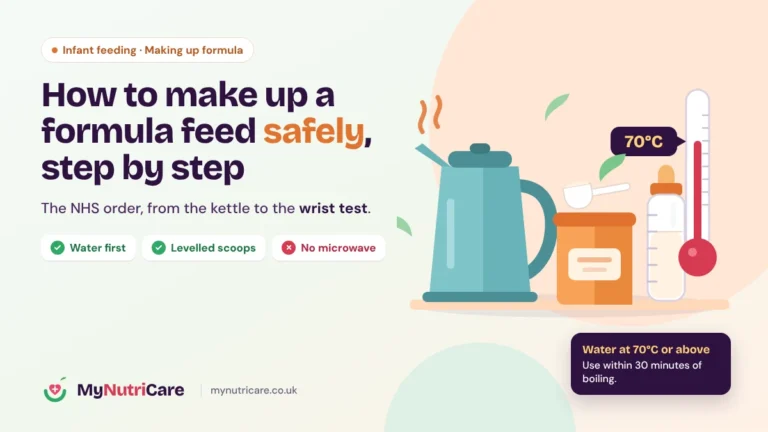
Be careful not to give your child 2 supplements at the same time, as too much of some vitamins can be harmful. If you are under 18 or on benefits, you may be entitled to free Healthy Start vitamin drops and food vouchers. Formula feeding? See Formula Feeding Basics and our step-by-step guide to making up a formula feed safely. Expressing? Check how long expressed breast milk keeps.
Ready to start? Take the guesswork out of the first weeks
Our infant feeding courses turn this guide into a plan you can follow day by day. Not sure which one fits? Our guide to picking a course by goal can help.
Starting Solid Foods
From readiness signs to your first fortnight of foods, with an allergen log, a baby food diary and a gagging vs choking card.
Baby-Led Weaning Education
Finger foods done safely: the right shapes and sizes, gagging vs choking, and a first foods tracker.
Food Allergy Awareness for Parents
Calm, practical allergy know-how for families: label checking, eating out, nursery and school forms and an emergency information sheet. For a closer look, see our guide: Formula Feeding Amounts.
Related guides
- Baby-led weaning vs purées: choosing an approach and safe finger food shapes.
- Gagging vs choking in babies: the signs and NHS first aid.
- How much formula by age: NHS amounts and feeding cues.
Questions parents ask
Can I start weaning at 4 months?
The NHS advises waiting until around 6 months, even if baby food labels say a product is suitable from 4 months. If your baby seems hungrier before then, a little extra milk may help. Talk to your health visitor or GP if you are thinking of starting early.
What are the signs my baby is ready for weaning?
The NHS lists three signs that appear together from around 6 months: your baby can stay sitting and hold their head steady, can look at food, pick it up and put it in their mouth by themselves, and can swallow food rather than spit it back out.
Is waking at night a sign my baby is ready for solids?
No. The NHS says waking at night, chewing fists and wanting extra milk feeds are normal baby behaviours, not signs of readiness. Starting solids will not make your baby more likely to sleep through the night.
How much food does my baby need when starting solids?
Only a small amount, once a day, offered before their usual milk feed. Milk still gives most of their energy and nutrients. From about 7 months they gradually move towards 3 meals a day.
Can my baby drink water when weaning?
Yes. From around 6 months, offer sips of water with meals in an open cup or a free-flow cup without a valve. Avoid juice, smoothies and sugary drinks, and do not give cows' milk as a main drink until 12 months.
When should a premature baby start weaning?
The NHS says to ask your health visitor or GP for advice on when to start introducing solid foods.
When can my baby have peanuts and eggs?
From around 6 months, one at a time and in very small amounts, with peanuts crushed or ground into food, or peanut butter spread on food, never whole. Once tolerated, keep offering them. Check with your GP or health visitor first if your baby has eczema or a food allergy, or there is a family history of allergies.
Is gagging normal when starting solids?
Yes. The NHS describes gagging as a normal reflex while babies learn to chew and swallow. Gagging is loud, with watery eyes. Choking is quiet, and the lips, gums or fingernails may look blue. Choking needs immediate action. You can browse every course and guide on the My Nutri Care home page.
Sources
- NHS: Your baby's first solid foods (last reviewed 19 February 2026)
- NHS Best Start in Life: How to start weaning your baby
- NHS Best Start in Life: What to feed your baby from around 6 months
- NHS Best Start in Life: What to feed your baby from 7 to 9 months
- NHS Best Start in Life: Choking and gagging on food
- NHS Best Start in Life: Preparing food safely
- NHS Best Start in Life: Food allergies
- NHS Best Start in Life: Food and drinks to avoid
- NHS: Drinks and cups for babies and young children
- NHS Best Start in Life: Baby vitamins
- NHS: Food allergies in babies and young children
- NHS: Foods to avoid giving babies and young children (last reviewed 18 February 2026)
- NHS: Vitamins for children
- SACN: Feeding in the first year of life (2018)
This article is general information based on UK public health guidance. It is not medical advice. If your baby was born prematurely, has a health condition or allergy, or you have questions about your own baby, speak to your health visitor, GP or pharmacist.