Every part of a UK birth plan explained in plain English, from where you give birth to the first hour with your baby, plus the questions to ask your midwife.

Last reviewed 12 October 2026 · Checked against NHS guidance · 13 min read
The short answer
A birth plan tells your midwife, nurses and doctors what you would like during labour. The NHS checklist covers where you give birth, who is with you (including at an assisted or caesarean birth), equipment and a birthing pool, staying active and positions, pain relief, skin-to-skin, trainees, feeding and vitamin K. Add a few "what if" lines for induction, assisted birth and caesarean, talk it through with your midwife, and write it so it still works if things change.
Most of our pregnancy guides are about food, starting with the pregnancy food safety checklist. This one is about the day itself. A birth plan is not a contract and nobody marks it. It is one page that tells people you may never have met what matters to you.
What a birth plan is for
The NHS describes a birth plan as a record of what you would like to happen during labour: where you give birth, who is with you and which facilities you would like to use. The NHS offers a free template as a Word document.
The NHS is clear that birth does not always go to plan and things may change at the last minute. The real value is the conversation: the NHS asks you to talk your choices through with your midwife so they can advise you.
When to write it: the NHS appointment timeline
There is no fixed week for writing a birth plan, but your antenatal appointments are built around these conversations. The NHS appointment schedule says your midwife will:
- 8 to 12 weeks (booking): give you information about your options for giving birth.
- 25 weeks (first babies): talk about your choices and preferences for giving birth.
- 28 weeks (everyone): give you information about labour and birth, including newborn screening.
- 31 weeks (first babies): discuss preparing for the birth, your preferences for birth and knowing when you are in labour.
- 34 and 36 weeks (everyone): the same discussion. At 36 weeks your midwife also feels your bump to check your baby's position.
- 38, 40 and 41 weeks: discuss your choices if you are still pregnant after 40 or 41 weeks, which is where induction comes in.
A practical approach: draft it in the early 30s, take it to your next appointment, and settle it by 36 weeks. The NHS says you can change your mind about where to give birth at any point.
The plan, section by section
These ten sections cover all 13 NHS checklist points, plus the "what if" topics the checklist leaves out: induction, tears and caesarean birth.
Where you want to give birth
You can give birth at home, in a midwifery unit (also called a birth centre) or in hospital. What is right depends on your health, your pregnancy and what is available locally.
Home
- For straightforward pregnancies
- No epidurals; gas and air, a pool and TENS are options
- First baby: risk of a serious problem for the baby is 9 in 1,000, against 5 in 1,000 in hospital
- After a previous baby: as safe as hospital or a midwife-led unit
Midwifery unit
- Part of a hospital or separate
- Separate units have no immediate obstetric, neonatal or anaesthetic care and no epidurals
- Low-risk births here are less likely to need forceps or ventouse
Hospital
- Direct access to obstetricians, anaesthetists and neonatal specialists
- You are more likely to have an epidural, an episiotomy or a forceps or ventouse birth
Doctors may recommend hospital in some situations, for example twins or a breech baby.
Who is with you, and who is in the room
The NHS checklist asks three things: who you want with you in labour, whether you want company if you need a forceps or vacuum (ventouse) birth or a caesarean, and whether you are comfortable with midwives, nurses and doctors in training being present. For a closer look, see our guide: What to Eat in a Day When Pregnant.
A birth partner can remind you to breathe, help you change position, keep you fed and watered, and speak up for your wishes. The NHS asks partners to help write the plan, or at least know what it says. At a caesarean under a spinal or epidural, your birth partner can usually be with you; under a general anaesthetic they will not normally be present.
Pain relief
The section most likely to change on the day. Many people write a starting preference plus "and I would like to keep my options open".
| Option | What it is | Worth knowing | At home? |
|---|---|---|---|
| Self-help | Breathing, moving, massage, a bath | Paracetamol can help in early labour | Yes |
| TENS | Small battery stimulator with pads on your back | Probably most useful in early labour and for back pain; not shown to work in active labour | Yes |
| Water | A bath or birth pool | Helps you relax; water kept no higher than 37.5C | Yes (pool) |
| Gas and air | Oxygen and nitrous oxide, breathed through a mask or mouthpiece you control | Takes 15 to 20 seconds to work; may make you lightheaded | Yes |
| Pethidine or diamorphine | Injection into the thigh or buttock | Lasts 2 to 4 hours; not advised close to pushing, may affect baby's breathing and first feed | Ask your midwife |
| Remifentanil | Into a vein; you press a button | Works fast and wears off in minutes | Ask your midwife |
| Epidural | Local anaesthetic given by an anaesthetist | Often complete relief; needs continuous monitoring; may raise the chance of forceps or ventouse | No |
Availability varies by unit. Ask your midwife what your chosen place offers.
Epidural: the trade-offs the NHS lists. In most cases it gives complete pain relief and should not make you sick or drowsy, which can help in a long or very painful labour. Against that:
- It takes 20 minutes or more to set up and work, and may need adjusting.
- Your legs may feel heavy, and you may find it hard to pee, so a catheter may be used.
- It can make the pushing stage longer. If you cannot feel contractions, your midwife will tell you when to push, and forceps or ventouse may be needed.
- About 1 in 100 people get a headache afterwards, which can be treated. Your back may be sore for a day or two, but it does not cause long-term backache.
The NHS says most alternative therapies, such as hypnosis or aromatherapy, are not proven to relieve labour pain; tell the hospital in advance if you plan to use one.
Moving, positions, water and equipment
The NHS checklist asks about staying active, positions, and equipment such as mats, beanbags or a pool. NHS labour advice says staying upright and gently active in early labour helps, you can use any comfortable position in established labour, and for pushing you might sit, lie on your side, stand, kneel or squat. Kneeling on all fours may help with backache. Try positions before labour starts.
Monitoring your baby
Not on the NHS checklist, but it affects how much you can move. In straightforward labour your midwife checks your baby's heart with a handheld device every 15 minutes and you can move around. Electronic monitoring (two pads on your bump) is used if there are concerns or you have an epidural. If it was for a concern, you can come off it once the heartbeat is shown to be normal. "Mobile" epidurals need wireless monitoring, which the NHS says many hospitals lack.
If labour needs a start: sweeps, induction and waters breaking
Worth a few lines in case labour does not start on its own.
- Membrane sweep. Usually offered after 39 weeks, before induction. A finger is swept around your cervix during an internal examination, which may start labour. It can be uncomfortable, with some cramping or bleeding. If labour does not start, you may be offered another sweep or induction.
- Induction. Offered if labour has not started by 41 weeks, because the risk of stillbirth and other problems rises, and sometimes earlier for health reasons such as diabetes or high blood pressure. It always happens in a hospital maternity unit. Hormones are usually tried first, and it often takes many hours.
- Pain relief is not restricted. The NHS says all the usual options, including an epidural or a water birth, should still be available if you are induced. Induced labour is usually more painful, and forceps or ventouse are more likely.
- It is your decision. Your midwife and doctor should explain the pros and cons. If you go past 42 weeks and decide not to be induced, you should be offered extra monitoring of your baby.
- Waters breaking. Call your midwife or maternity unit urgently. If your waters break after 34 weeks and labour has not started, you can choose induction or waiting with monitoring. The NHS notes the risk of infection rises if your waters break more than 24 hours before labour starts.
Assisted birth, tears and episiotomy
About 1 in 8 births need forceps or ventouse (vacuum), less often if you have had a vaginal birth before. Reasons include concerns about your baby's heart rate, your baby being in an awkward position or showing signs of distress. It usually happens in the birthing room, with a local anaesthetic if you have no epidural. Depending on the circumstances, your baby may be placed on your tummy and your birth partner may still be able to cut the cord.
Up to 9 in 10 first-time mothers having a vaginal birth have a tear, graze or episiotomy. In England an episiotomy (a small cut to widen the opening) is not routine. Things the NHS says can help:
- Perineal massage in the last few weeks of pregnancy can reduce the chance of an episiotomy; daily massage showed the most benefit.
- As the head appears, your midwife may ask you to stop pushing and pant gently so it is born slowly.
- Small tears are often left to heal on their own. Larger tears and cuts are stitched with dissolvable stitches, with a local anaesthetic or an epidural top-up, and you should be able to keep cuddling your baby.
Caesarean birth: planned, emergency and next time
A caesarean can be planned (usually from 39 weeks) or an emergency during labour.
- On the day. A spinal or epidural is usually used, so you stay awake and your birth partner can usually be with you. A general anaesthetic is used only if you cannot have one; your partner will not normally be present then. A screen is placed across your tummy, your baby is lifted up for you to see, and you can usually hold them straight away. NHS breastfeeding guidance says you should still be able to have skin-to-skin straight after delivery.
- Afterwards. Staff can help you breastfeed if you want to. If there are no complications, most people go home 1 to 2 days after surgery.
- Asking for a caesarean. You can ask for one without a medical reason. Your midwife or doctor should talk through the risks and benefits, and if anxiety about birth is the reason you should be offered support. If you still want one, you should be offered a planned caesarean or referred to a doctor who will do it.
- Birth after a previous caesarean. Most people can safely have a vaginal birth next time, though you may need extra monitoring in labour, and some are advised to have another caesarean. Talk this through with your midwife early, because it shapes the rest of your plan.
The first hour after birth
These choices happen fast, so decide them in advance.
- Skin-to-skinYour baby can be placed on you as soon as they are born, before the cord is cut. If you would prefer, ask for your baby to be dried and wrapped first.
- Cord clampingWith active management, the NHS says the cord is cut between 1 and 5 minutes after birth (sooner if there are concerns). With physiological management, it is left until it stops pulsing, usually 2 to 4 minutes.
- Delivering the placentaActive: an oxytocin injection, the placenta usually out within about 30 minutes and a lower risk of heavy bleeding, but more chance of sickness and afterpains. Physiological: no injection; it can take up to an hour, switching to active if needed.
- Vitamin KOffered to prevent a rare bleeding disorder in newborns. It is usually an injection; if you prefer, it can be given by mouth, but that needs further doses.
- FeedingSay how you plan to feed your baby. If you plan to breastfeed, the NHS says skin-to-skin straight after birth is a great time for your first feed, and your midwife can show you how. If you plan to use formula, say so too, so staff know what you need. Our guides to making up a bottle of formula safely and storing expressed breast milk help you prepare either way.
About me
This is not on the NHS checklist, but a short line at the top saves you explaining yourself in labour. Some ideas people find useful: the language you would like to be spoken to in, or whether you need an interpreter; any disability or access needs; religious or cultural wishes; and anything from a past birth or your health history that staff should know. Ask your midwife what your unit can arrange, and whether it should go in your maternity notes as well. You can browse every course and guide on the My Nutri Care home page.
Birth preferences quick builder
Tap your preferences in each group. A plain-text summary appears below for you to copy into your notes or the NHS template. Nothing is saved.
Group 1
Where would you like to give birth?
Birth partner (optional)
Group 2
Pain relief you would like to try
Group 3
During labour
Group 4
After the birth
Group 5
Feeding and vitamin K
Your summary
Tap a preference above to start your summary.Copied
A quick draft only, with nothing saved. The Creating a Birth Plan course has the full flexible plan template, a question list for your midwife and a briefing sheet for your birth partner.
Writing it so it bends
A few habits keep a plan useful when things change:
- One page, short lines. Put the three things that matter most at the top.
- Preferences, not rules. "I would prefer" leaves room for a conversation.
- Add an "if" for each big wish. If you need theatre, what still matters?
- Keep it with your notes. The NHS hospital bag list includes your birth plan and hospital notes. If your trust uses digital maternity notes, ask your midwife where your preferences should be recorded, and give your birth partner a copy.
- Revisit it at 36 weeks, when things may have changed.
Questions to ask your midwife before you finish it
These are the points where NHS guidance says the answer depends on your unit:
- Is the midwifery unit alongside the hospital or separate, and how long does a transfer take?
- Is a birth pool usually available, and what happens if it is in use?
- Are anaesthetists always available for epidurals here?
- Do you have wireless monitoring, so I can move with an epidural or monitoring?
- How does induction work here, and might I be able to go home during it?
- Is there anything in my health or pregnancy, such as a previous caesarean, that changes my options?
This is not medical advice
Your options depend on your health, your pregnancy and your maternity unit. Your midwife or doctor will talk through any change in the moment and help you make the safest decision for you and your baby. If you have concerns at any point in pregnancy, or your baby's movements slow down or change, contact your midwife or maternity unit straight away.
A plan that still works when things change
The Creating a Birth Plan course (Focused, 2 hours, £12.99) walks you through your options, then gives you a flexible birth plan template, a full list of questions for your midwife and a one-page briefing sheet for your birth partner.
See the courseFirst 6 Weeks with Baby (£17.99)Planning ahead? See our infant feeding and postnatal courses, or the course finder.
Related guides
- How much formula your baby needs: NHS amounts by age.
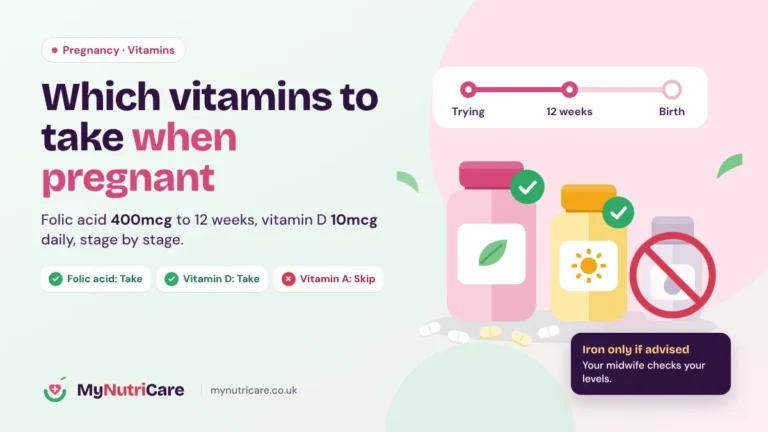
- Vitamins in pregnancy and breastfeeding: folic acid, vitamin D and iron.
- A balanced pregnancy day: three meals and two snacks, NHS-based.
Questions people ask
What should I put in a birth plan?
The NHS checklist covers where you want to give birth, who you want with you (including at a forceps, ventouse or caesarean birth), equipment and a birthing pool, staying active and labour positions, pain relief, skin-to-skin before the cord is cut, whether trainees can be present, how you want to feed your baby, and whether your baby can have vitamin K.
When should I write my birth plan?
There is no set week. Your midwife discusses your choices and preferences for birth at antenatal appointments, including at 25 and 31 weeks for a first baby and at 34 and 36 weeks for everyone. Many people draft it in the early third trimester and finalise it by 36 weeks.
Is there an NHS birth plan template?
Yes. The NHS offers a free birth plan template as a Word document on its how to make a birth plan page.
Can I change my birth plan?
Yes. The NHS says you can change your mind about where to give birth at any point in pregnancy, and that plans may change at the last minute.
Can I have an epidural at a birth centre or at home?
Not at home, and not at a midwifery unit separate from a hospital, because only an anaesthetist can give an epidural.
What is delayed cord clamping?
Waiting before the cord is cut. The NHS says the cord is cut 1 to 5 minutes after birth with active management, or left until it stops pulsing (usually 2 to 4 minutes) with physiological management.
Can I still have a water birth or an epidural if I am induced?
The NHS says induction does not limit your pain relief options, and all the usual options, such as an epidural or a water birth, should be available. Induced labour is usually more painful than labour that starts on its own.
Can I ask for a caesarean in the UK?
Yes. Your midwife or doctor should explain the risks and benefits compared with a vaginal birth, and offer support if anxiety is the reason. If you still want a caesarean, you should be offered a planned one, or be referred to a doctor who will do it.
Sources
- NHS: How to make a birth plan (includes the NHS birth plan template)
- NHS: Where to give birth: the options (page last reviewed 29 April 2024)
- NHS: Pain relief in labour
- NHS: The stages of labour and birth
- NHS: What happens straight after the birth
- NHS: Tips for your birth partner
- NHS: Caesarean section and what happens
- NHS: Inducing labour
- NHS: Forceps or vacuum delivery
- NHS: Episiotomy and perineal tears
- NHS: Breastfeeding, the first few days
- NHS: Pack your bag for labour
- NHS: Your antenatal appointments (page last reviewed 17 April 2026)
General information based on NHS guidance, not medical advice. Speak to your midwife or doctor about your own pregnancy.