Gagging is noisy and part of learning to eat. Choking is quiet and needs you to act at once. How to tell them apart, the NHS first aid steps for a baby under 1, and how to cut food more safely.

Last reviewed 12 October 2026 · Checked against NHS guidance · 15 min read
The short answer
Gagging is loud; choking is quiet. The NHS describes gagging as a normal reflex while your baby learns to chew and swallow: you may see watery eyes, the tongue pushed forward and retching to bring food forward. Stay with them. Choking is different. If your baby goes quiet, their cough is silent or they cannot breathe in properly, or their skin starts to look blue (on brown or black skin, check the gums, inside of the lips or fingernails), shout for help and start back blows straight away. For a baby under 1, the NHS uses up to 5 back blows, then up to 5 chest thrusts, and you call 999 if the blockage does not come out.
If you are still deciding when to start, read our guide to when to start weaning and the signs your baby is ready first. This article goes into one question in depth: in the moment, how do you know whether to wait or act?
Gagging vs choking: the signs, side by side
The single most useful clue is sound. The NHS puts it plainly: gagging is loud, choking is quiet.
Signs your baby is gagging
- It is loud. You hear the gag, the splutter or the retch.
- Their eyes may water.
- Their skin may look red, although the NHS notes this is harder to see on brown and black skin.
- They push their tongue forward, or out of their mouth.
- They retch or vomit to bring the food forward in their mouth.
Signs your baby is choking
- It is quiet. The sound stops, or there was never much sound at all.
- Their cough is not working. The NHS describes an ineffective cough as one that is silent, or where your child cannot breathe in properly.
- Their colour changes. On white skin, the skin may begin to look blue. On brown or black skin, the gums, the inside of the lips or the fingernails may begin to look blue.
- It comes on suddenly. The NHS says there is a good chance a child is choking if they suddenly start coughing, are not ill, and have been eating or have a habit of putting small objects in their mouth.
A loud cough is a good sign: the NHS says to encourage your child to keep coughing and stay with them. You step in when the cough goes silent or stops working.
Why babies gag so much when they start solids
Gagging is expected. The NHS says your baby may gag when you introduce solid foods and that this is totally normal. It happens because they are learning to regulate the amount of food they can chew and swallow at one time.
That is why gagging tends to show up at moments of change:
- The first few weeks of solids, when everything in the mouth is new.
- New textures. The NHS advises moving your baby on from puréed or blended foods to mashed, lumpy or finger foods as soon as they can manage them. Some babies take longer to get used to new textures, but the NHS says to keep offering lumpy textures and they will eventually get used to them.
- Harder or bigger pieces. The NHS says babies will eventually learn to cope with different textures and harder foods.
So gagging is not a reason to go back to smooth purées for good. Lumpier foods are how your baby learns.
Does baby-led weaning cause more choking?
Many parents worry that finger foods mean more choking. The NHS is clear: there is no more risk of choking when a baby feeds themselves than when they are fed with a spoon. What matters more is how the food is prepared and that your baby is sitting upright and supervised. If you are weighing up the two approaches, our guide to baby-led weaning vs purées compares them in detail.
What to do while your baby is gagging
Watching your baby gag is hard, but the best response is usually the calmest one.
- Stay close and keep watchingThe NHS says to always stay with your baby when they are eating in case they start to choke.
- Stay calm and let them work it forwardThe NHS explains that a retching movement, or being sick, is how your baby brings the food forward in their mouth. They may also push their tongue forward or out. This is the reflex doing its job.
- Do not poke blindly into their mouthThe NHS first aid page says that if you can see an object you can try to remove it, but not to poke blindly or repeatedly with your fingers. You could make things worse by pushing the object further in and making it harder to remove.
- Listen for the switch to quietIf the noise stops, the cough goes silent, they cannot breathe in properly or their colour changes, treat it as choking and start first aid.
Is this gagging or choking? A 4-question check
Try it now, while calm, so the signs feel familiar. In a real emergency, do not stop to use a tool: act. Nothing is saved.
What can you hear?
Can your baby breathe in properly?
If they are coughing, what is the cough like?
Any blue colour?On white skin, the skin itself. On brown or black skin, the gums, inside of the lips or fingernails.
Answer the questions above
Your result will appear here as you go.
A learning aid based on NHS signs, not a substitute for first aid training or medical advice. The Starting Solid Foods course includes a gagging vs choking card.
If your baby is choking: NHS first aid for babies under 1
These steps follow the NHS page How to stop a child from choking. Read them now, not for the first time in an emergency.
First, check the cough
- If you can see the object, try to remove it. Do not poke blindly or repeatedly with your fingers.
- If your baby is coughing loudly, encourage them to carry on coughing to bring up what they are choking on, and do not leave them.
- If the cough is not effective (it is silent or they cannot breathe in properly), shout for help immediately and check whether they are still conscious. If they are conscious, use back blows or chest thrusts.
- Give up to 5 back blows
- If your baby is in a high chair, get them out of it first.
- Sit down and lay your baby face down along your thigh or forearm, supporting their head and neck with your hand.
- Give up to 5 sharp back blows with the heel of your hand in the middle of your baby's back, between their shoulder blades.
- Check whether the object has come out between each blow. You may not need to use all 5.
- If that has not worked, give up to 5 chest thrusts
- Lay your baby face up along the length of your thighs, with their feet closest to you and their head furthest away and lower than their feet.
- Place 2 fingers in the middle of their chest, just below the nipple line.
- Give up to 5 sharp chest thrusts (pushes). Check whether the object has come out between each thrust. You may not need to use all 5.
- Keep going and get help
- If the object is still stuck and your baby is still conscious, continue the sequence of back blows and chest thrusts.
- Call out or send for help if you are still on your own. Do not leave your baby.
- Call 999 if the blockage does not come out after trying back blows and chest thrusts. Keep trying this cycle until help arrives.
- If your baby becomes unconscious
- Put them on a firm, flat surface and shout for help.
- Call 999, putting the phone on speakerphone so your hands are free. Do not leave your baby at any stage.
- Open their mouth. If the object is clearly visible and you can grasp it easily, remove it.
- Start CPR, following the NHS steps for how to resuscitate a child.
The NHS says you may need to use more than one method, that the order does not matter, and that if one method does not work, you try the other. For babies under 1, the NHS method is chest thrusts, not abdominal thrusts.
If your child is over 1
Once your child has turned 1, the NHS swaps chest thrusts for abdominal thrusts. The checks at the start (see the object, encourage a loud cough, shout for help if the cough is silent) and the 999 and unconscious steps stay the same.
- Back blows: lay a small child face down on your lap as you would a baby. If this is not possible, support your child in a forward-leaning position and give 5 back blows from behind.
- Abdominal thrusts: stand or kneel behind your child and place your arms under their arms and around their upper abdomen. Clench your fist and place it between the navel and the ribs, grasp it with your other hand and pull sharply inwards and upwards. Repeat up to 5 times, checking whether the object has come out between each thrust.
- Avoid the lower ribcage. The NHS says not to apply pressure there, as this may cause damage.
Book a baby first aid course
Reading steps is not the same as practising them. The NHS says it is highly recommended that every parent or carer goes on a first aid course, and its pages point to the British Red Cross public first aid courses. A hands-on course lets you practise back blows, chest thrusts and baby CPR, so the steps come back to you under pressure.
After a choking episode: get your baby checked
Even if the food has come out, get medical help
The NHS says to get medical help even if the object has come out. Part of it might have been left behind, or your baby might have been hurt by the back blows or chest thrusts.
If your baby gags so often that meals feel impossible, or you are worried about how they are coping with textures, talk to your health visitor or GP.
How to lower the risk of choking at mealtimes
The NHS says choking can happen with any food, but firm foods, bones and small round foods can be more risky, especially when children do not chew their food well. Its steps for safer mealtimes come down to five habits:
- Start at the right time. Introduce solid foods from around 6 months, not before.
- Sit them upright in a high chair. Babies need to be alert and seated safely upright while eating, so they can swallow properly.
- Always supervise. Stay with your baby for the whole meal and snack, every time.
- Think about size, shape and texture. Cut food into narrow batons and avoid round shapes and firm foods.
- Encourage proper chewing. Encourage your baby to chew and swallow food properly, and not to rush eating.
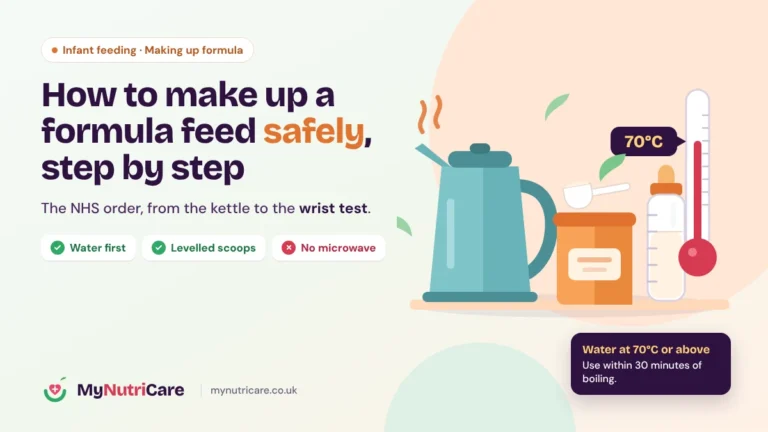
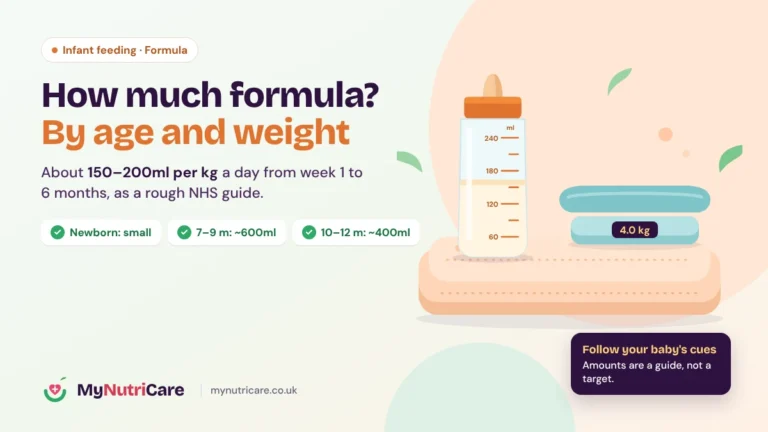
Bottles count too. The NHS says never to leave your baby alone to feed with a propped-up bottle, or alone in bed with a bottle, because they may choke on the milk. For safe bottle preparation from the start, see our guide to making up formula the NHS way. For a closer look, see our guide: Formula Feeding Amounts.
Choking also happens during play. The NHS says children, particularly those aged 1 to 5, often put objects in their mouth, and that small objects such as marbles, beads and button batteries are just the right size to get stuck in a child's airway. The best way to avoid this is to keep them out of your child's reach.
For finger foods, the NHS suggests pieces big enough for your baby to hold in their fist with a bit sticking out; pieces about the size of your own finger work well.
How to cut food safely: grapes, batons, bread and more
The NHS Preparing food safely page goes food by food. Here is what it says, grouped so you can scan it while you cook.
| Food | How the NHS says to prepare it |
|---|---|
| Grapes, cherries, berries, strawberries, cherry tomatoes | Cut into quarters (4 small pieces). |
| Fruit with pips or stones | Always remove hard pips or stones. |
| Melon, apples and other large or firm fruit | Cut into slices rather than small chunks. For very young children, try grating, mashing, steaming or simmering firm fruit. |
| Carrots, peppers, cucumber, celery | Cut into narrow batons. |
| Firm fruit and vegetables (carrots, broccoli, yam, apples) | Soften by steaming or simmering until soft, then cut into slices or narrow batons. Removing the skin makes them easier to swallow. |
| Sausages and hot dogs | Cut into short strips. |
| Meat and fish | Remove all bones. Cut meat into strips as thinly as possible, and remove skin and fat. |
| Cheese | Grate it, or cut into short, narrow strips. |
| Nuts, peanuts and seeds | Chop or flake them. No whole nuts or popcorn for children under 5. |
| Bread, chapatis, naan | Cut into narrow strips. If not chewed properly, white bread can form a dough-like ball in the throat. |
| Peanut butter and other nut butters | Never by itself. From the start of weaning it can be spread on food, such as toast. |
| Raisins and other dried fruit | No whole raisins or dried fruit under 1. Always cut into small pieces. |
The NHS also says to avoid hard foods like whole nuts, or raw carrot or apple, which is why steaming and grating help in the early months.
Offering finger foods from the start? Baby-Led Weaning Education walks you through safe shapes and sizes food by food, with a first foods tracker.
Foods babies and young children should not have
Some foods are not about cutting technique: the NHS says babies and young children should not have them at all, because they are all choking hazards.
Whole nuts and peanuts are on the list too. The NHS says that when left whole, nuts can get stuck in the throat and cause choking, so they should not be given whole to children under 5. Crushed or ground nuts mixed into food can be given from the start of weaning (usually around 6 months). If there is a history of food allergies or other allergies in your family, talk to your GP or health visitor before introducing any type of nut.
Keep the signs by the high chair
Recalling the signs in a panicky second is hard. Our weaning courses give you a card to keep handy.
Starting Solid Foods
From readiness signs to your first fortnight of foods, with an allergen log, a baby food diary and a gagging vs choking card to keep by the high chair.
Baby-Led Weaning Education
Finger foods done safely: the right shapes and sizes, gagging vs choking explained, and a first foods tracker.
Our courses are education, not first aid training. Please also book a hands-on baby first aid course.
Related guides
- Formula amounts once solids start: how milk changes from 6 to 12 months.
- Finger food shapes and sizes: baby-led weaning vs purées compared.
- Breast milk storage times: fridge, freezer and cool bag rules.
Questions parents ask
How can I tell if my baby is gagging or choking?
Listen. The NHS says gagging is loud and choking is quiet. A gagging baby may have watery eyes, push their tongue forward and retch to bring food forward. A choking baby may go silent, have a cough that is silent or not working, be unable to breathe in properly, or start to look blue (on brown or black skin, check the gums, inside of the lips or fingernails). For a closer look, see our guide: Baby-Led Weaning or Purées.
Is it normal for my baby to gag on food?
Yes. The NHS describes gagging as a normal reflex while babies learn to chew and swallow, because they are learning how much food they can manage at one time. Stay with your baby and let them bring the food forward, and do not poke blindly into their mouth.
What do I do if my baby under 1 is choking?
If the cough is not working, shout for help. Lay your baby face down along your thigh or forearm, supporting their head, and give up to 5 sharp back blows between the shoulder blades. If that fails, lay them face up along your thighs and give up to 5 chest thrusts with 2 fingers just below the nipple line. Call 999 if the blockage does not come out, and keep repeating until help arrives.
What should I do if my toddler over 1 is choking?
Use back blows first: lay a small child face down on your lap, or support them leaning forward and give up to 5 back blows from behind. If that fails, the NHS uses abdominal thrusts for children over 1, not chest thrusts: from behind, place a clenched fist between the navel and ribs and pull sharply inwards and upwards, up to 5 times, without pressing on the lower ribcage. Call 999 if the blockage does not come out.
Should I see a doctor after my baby has choked?
Yes. The NHS says to get medical help even if the object has come out, because part of it might have been left behind or your baby might have been hurt by the first aid.
Does baby-led weaning increase the risk of choking?
No. The NHS says there is no more risk of choking when a baby feeds themselves than when they are fed with a spoon. Sit your baby upright, stay with them and prepare food in safe shapes, such as narrow batons.
How should I cut grapes for my baby?
The NHS advises cutting small round fruits like grapes, cherries, berries, strawberries and cherry tomatoes into quarters, which means 4 small pieces. Remove any hard pips or stones.
Sources
- NHS Best Start in Life: Choking and gagging on food
- NHS: How to stop a child from choking (last reviewed 28 October 2024)
- NHS: How to resuscitate a child (last reviewed 21 May 2026)
- NHS Best Start in Life: Preparing food safely
- NHS Best Start in Life: Food and drinks to avoid
- NHS: Foods to avoid giving babies and young children (last reviewed 18 February 2026)
- NHS: Bottle feeding advice (last reviewed 2 April 2024)
- NHS: Your baby's first solid foods (last reviewed 19 February 2026)
This article is general information based on UK public health guidance. It is not medical advice and does not replace a first aid course. If your baby is choking and the blockage does not clear, call 999. For questions about your own baby, speak to your health visitor, GP or pharmacist.